My Blog List

Monday, 15 February 2016

GSW

I haven't posted any woodpecker photos for at least two weeks so here are a few from the garden today.  All taken with a Canon 300 prime lens while I was waiting for the courier to bring the Sigma 150-600 back from repair.  The last shot shows that woodpeckers like sunflower hearts as well but he was almost too close.  The birds look very smart at this time of year, all in their Sunday best hoping to attract mate.


Saturday, 13 February 2016

Bird of the week - Tufted duck

The tufted duck (Aythya fuligula) is our commonest diving duck.


The male is especially handsome and, like so many "black and white" birds, has purple, green and blue colours in his feathers.  He even has a hipster hairstyle!

The population of tufted ducks increased markedly over 100 years ago after the colonisation of the UK by zebra mussels.  More recently numbers have been fairly stable.  This graph is from the BTO/JNCC/RSPB Breeding Bird Survey.

The BTO Bird Atlas distribution maps show that tufted ducks are widespread in much of England apart from the north west and south west, with fewer in Wales and Scotland.  Many of our winter tufted ducks are continental visitors.  The overwintering population is over 100,000 birds with fewer than 1 in 6 staying to breed.


Wednesday, 10 February 2016

Return of the starlings

Starlings have returned to the garden over the couple of weeks or so.  Still sporting her winter plumage this one has been spending her time probing the lawn for invertebrates or feeding on the feeders - she prefers peanuts.  The males have started singing (at least they call it singing) in the tallest trees.


In the right light starlings have wonderful colours in their plumage with green in the wings and breast feathers and purple on the back and head.


Starlings nest in my garden each year - there were at least six pairs in holes in trees last year.  Looking through 21 years' data from my garden on the BTO Garden BirdWatch website I can see a big change comparing the past decade or so with the first ten years.  Starlings have always disappeared from the garden soon after the chicks fledge but used to return in the autumn and be here all winter.  More recently they have been arriving at about this time of year, in smaller numbers, ready to choose a nest hole.  This chart from Garden Birdwatch from 2003-2014 shows that starling numbers in gardens were at their lowest over the last three years.

These two graphs document the continuing decline in starlings in gardens, both in percentage of gardens with starlings and in the numbers birds per garden.


Although the starling was the second commonest bird in the RSPB Big Garden Birdwatch last year, numbers have declined by 80%  since the first Birdwatch in 1979.  Because of the decline in numbers the starling is on the IUCN Red List.

Monday, 8 February 2016

Mrs Smew (again)

I went to see Mrs Smew again.  Unlike last time she didn't catch a fish while I was watching but she did allow good views to see her sawbill.


It interesting that she prefers to hang out with the male goosanders who are also sawbills but are more than twice her size.  This a very distant photo but does allow a size comparison.  She has to paddle twice as fast to keep up with them.

Saturday, 6 February 2016

Bird of the week - Oystercatcher

The oystercatcher can catch oysters but it usually eats other molluscs or worms.  A noisy and eye-catching bird at the seaside, it also draws attention to itself by its loud piping call in flight.


The legs look pink to me but Haematopus ostralegus means blood-footed oyster-lifter.  

We are more used to seeing oystercatchers in ones and twos or small groups at the coast but they can mass in their thousands.


Oystercatchers are mostly confined to the coast in the southern half of the country but are more widespread in the north, especially in the breeding season.


Adult oystercatchers are relatively long-lived at 12 years but the record for a ringed bird is 40 years.  Numbers increased in the 70s and 80s but have been in decline more recently.

Listen to the BBC Radio 4 Tweet of the Day on oystercatcher here.

Friday, 5 February 2016

Hungry coal tits

I've found a new role in life - as a bird table.  Look out for the very indecisive bird who can't decide which is the best sunflower heart.  I hope the video works - it was recorded on an iPhone but, despite this, may not play on an iPad.


Wednesday, 3 February 2016

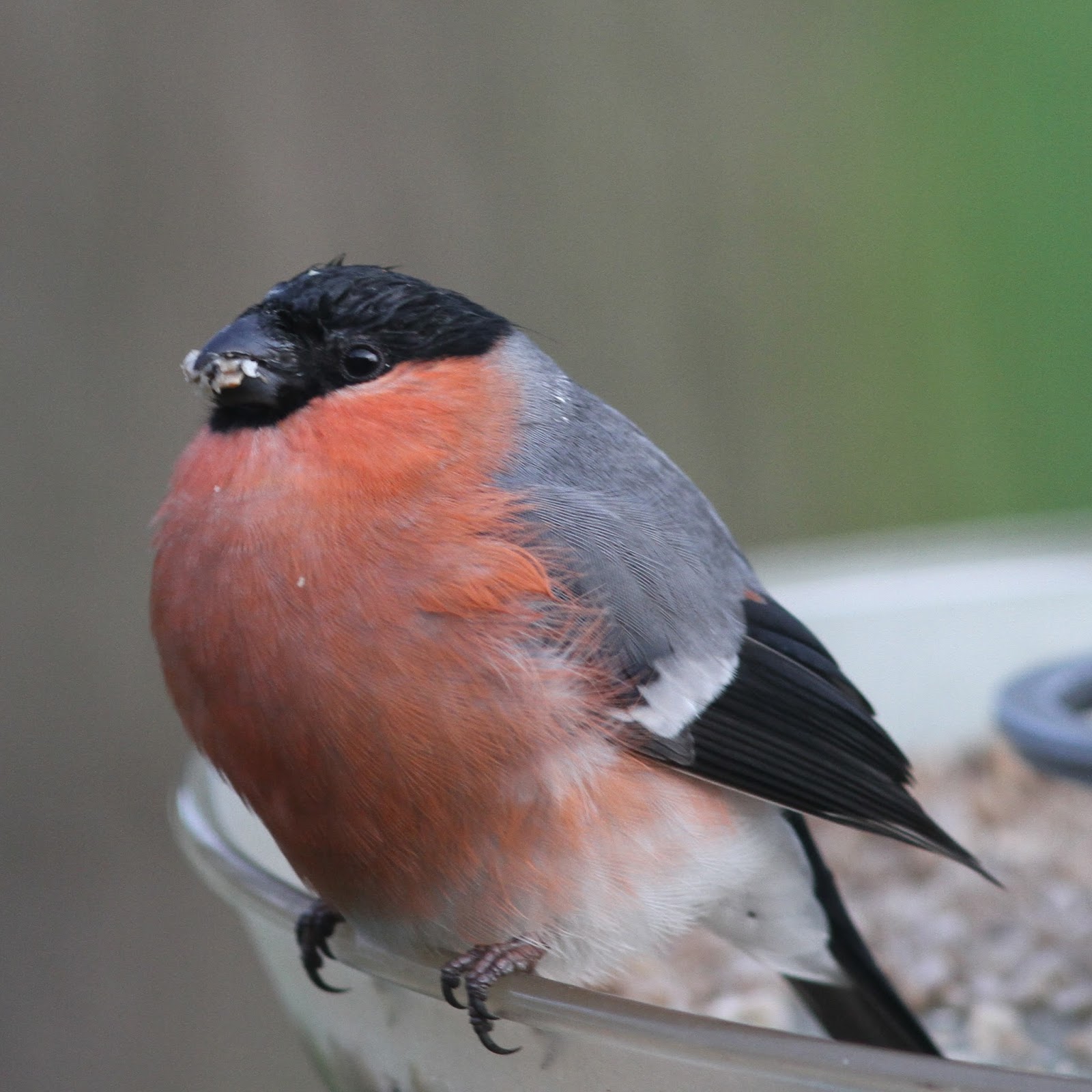
Sick finches

Oh dear.  Bad news.  Two of the bullfinches in my garden are sick.  They have been sitting around on or near the feeder, fluffed up, lethargic, with their heads held back and with food stuck on their beaks.  The symptoms suggest trichomoniasis, a protozoan infection with Trichomonas gallinae.  I have only seen it here once before, in a greenfinch a year ago.  Other possibilities are infection with Salmonella or Escherichia albertii.


I have reported it to Garden Wildlife Health in which the BTO is a partner.  Their usual advice is to keep the feeders clean (which I do anyway) and to suspend feeding if there are several victims.  The disease has been endemic in British finches for a decade and caused major mortality in greenfinches in 2006/7.  You can download the BTO fact sheet (they call it trichomonosis) here.