My Blog List

Thursday, 10 February 2022

Fox News

I haven't been able to see the foxes in my garden for the last two months, ever since Storm Arwen felled a tree that knocked out my wall lights.  With lighting finally restored I have been catching up on which foxes are visiting.  Trail camera monitoring last month showed lots of fox activity and several different foxes but I couldn't identify individuals on the infrared videos.

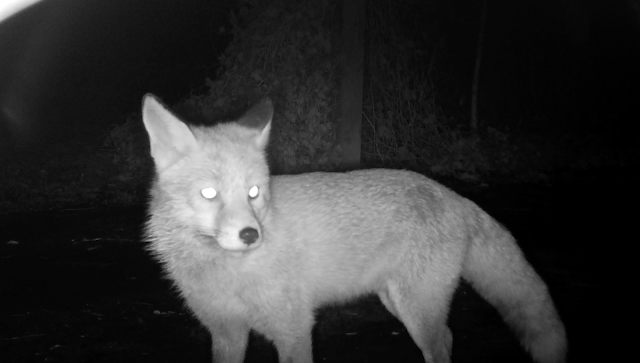
I am pleased to say that the dog fox and vixen from last year are both still here.  If the vixen has cubs the year this will be at least her third litter.  Here is the dog.  He is as fascinated by the new light as he was with the old one.


And this is the vixen.


The alpha pair sometimes arrive together and are very relaxed in each other's company although the vixen sometimes shows submissive behaviour.  Here she is looking bored in the background as he watches the light.

I have also seen at least four other foxes and possibly up to six.  Marc Baldwin says that dispersal (of full-grown cubs) usually takes place between September and February so it is interesting that so many foxes remain in this territory. Males disperse before females so I presume they are all female as the dog is unlikely to tolerate other full-grown males.  I am fairly sure there were two litters within the family group last year with up to ten cubs, so perhaps it isn't surprising that there are so many still around.

These are the individuals I can recognise.  This fox has marks on its face and a small notch on the left ear.


The following night it reappeared with a nasty wound on its forehead.


The next night, if anything, it looked worse when it was here with the alpha female, presumably its mother.


And last night it seemed to be on the mend.  All through the fox has seemed unaffected by the wound.  Foxes get a lot of wounds, injuries and scars, sometimes from fighting but also from climbing through and under fences and hedges in the dark.

The next fox is small and pale.  There were at least three cubs like this in the family group last year and at least two might still be here but, because I only see one at a time, it it is difficult to be sure.  I have watched one feed for 10 minutes before wandering off.  A few minutes later it, or a look-alike, returned for another feed.


The small fox certainly isn't timid and wouldn't let a larger fox near the food.  I am not sure which fox is in the background because it eventually gave up waiting and left.

It is difficult to get a photo to give an idea of the sizes difference between a normal fox and a small fox because I can rarely get them in the same frame at the same distance from the camera but this will give some idea.  It is really quite striking in real life.

Another fox has a dark scar below its right eye and has long black socks.


This is another large fox with bright colours, no obvious scars and also long black socks.


It will be interesting to see who remains in the family group in the next few weeks as the alpha pair will presumably be planning for the next generation.

Friday, 4 February 2022

Guest appearances on OtterCam

The otters are very used to my cameras and mostly ignore them or give them a sniff as they pass.  Badgers are less keen, both on the red light and the human scent.  They often don't seem to notice if they just walk past but soon beat a retreat if they spot a camera.  Here is one investigating the otter run.  It is in complete darkness of course and sniffs its way around.


On another evening twice a badger went down the gully and retreated when it saw the bottom camera.  The second time it returned to check out the top camera.

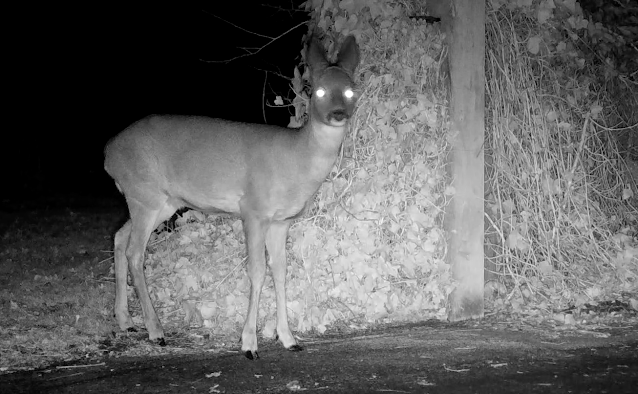
Roe deer largely ignore the camera but sometimes take an interest, probably in the hope that it is something to eat.


Other recent non-target species have been wood mouse, brown rat, moorhen, robin, blackbird, teal and mute swan but they don't make for an interesting video.

Thursday, 27 January 2022

OtterCam in January

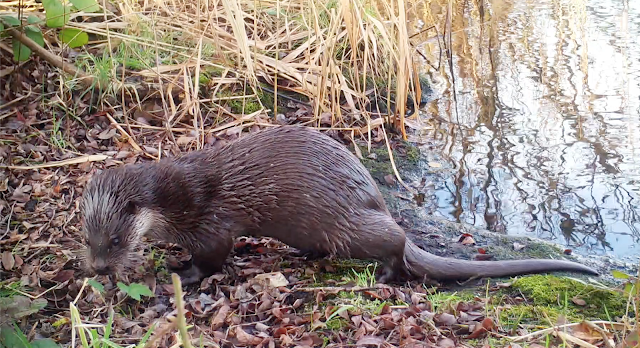
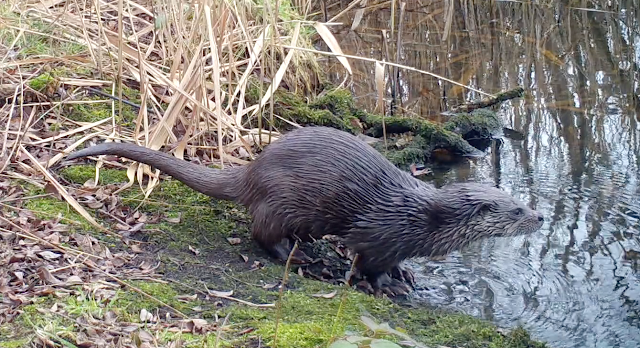
The otters have been putting on a show recently, appearing on the cameras several times in daylight.  One of the limitations of trail cameras is that the target has to be in the frame before the camera is activated and, with a 400ms activation time, it means that the start of the action is missed, a big deal if it is something very fast like a weasel. Another limitation is that Browning cameras record for only 20s at night, although they will restart very quickly and clips can be stitched together.  Just occasionally everything works out perfectly, as in this first video.  The dog otter swam into view briefly to activate the camera, disappeared momentarily, and reappeared for about 20s, all of which was recorded as the camera will run for up to 2 minutes in daylight.


Here is another daylight sequence, showing a smaller otter on two cameras, either last year's cub or the resident female.  It has been in the wars and has an injury on its upper lip, perhaps from fighting.  You can see that both otters were very aware of the camera.


This little gully is a favourite spot of the otters' (and mine) and they use it a lot for scent-marking, as well as a way of getting from the lake to the reed beds.  Here the dog pops in to sniff the camera and to check for messages and leave his own before returning to the water.  The bright sun and deep shadow made the lighting more difficult.


The next video records something I haven't seen before on the trail camera.  The dog otter caught a fish and sat down to eat it, tantalisingly just a few inches outside the field of view of the camera for the next four minutes, a case of what might have been.  We can hear the crunching noises but can't see the action.  When the otter came back for a drink and a scratch of course he was bang in the middle of the frame.  My friend Phil, an ace fisherman himself, tells me this is a perch, probably weighing about 8-12 oz.  Paul Chanin's book Otters says that a mature dog otter needs about 1.5kg of fish a day so this otter will eat 4-6 of these a day.


There was an auxiliary movement-triggered infrared light back left just out of view and you can see the improvement in the picture when it switches on.


After that I put in an extra camera at the top of the bank.  It was on a pole that has been in place for a long time but the camera was new and would have been silhouetted against the sky from the otter's viewpoint.  When I first saw this sequence of the otter with a sore nose I thought it had been spooked by the new camera and was trying to get by, even though it has been passing lower cameras every day for the last six months or more.  I now think it was just playing and towards the end you can see it was even trying to get the camera to join in.  It reminds me in a way of its distant cousin the stoat.  The sequence is a bit disjointed and was difficult to stitch together, partly because of the camera's reaction time and recording only 20s at a time, but I think it is worth seeing.


And finally the latest video from yesterday.  This again is the smaller otter calling in at the bottom of the bank to leave its scent mark.  At least one of these otters does this here every day.


Friday, 21 January 2022

Leaving the gate open

I can't see what is happening at the gate from the house in the dark so I have been using a trail camera to keep an eye on things.  I have been leaving the gate open for the deer who come in most nights.  Three nights ago the only two here were a buck and a doe but they came in at 2000 and left at 0500, so they were in the garden for nine hours.

In chronological order here is a taste of the action that night.  Two deer in and two deer out, eleven foxes in and four foxes out, but the foxes can leave in many other places.

Foxes will do anything for an easy life and I am sure they are delighted I have been leaving the gate open.  Usually they have to jump over or through the fence but now they can just stroll in.


The next video shows how things unfolded on one misty night earlier in the week.  A fox or a pair of foxes came and went through the gate 34 times in 11 hours between 2000 and 0700.  I can't tell how many individuals were involved but obviously several came in more than once.  The fox walking with a stiff tail is presumably a (or the) dominant male.  I haven't included all the clips here but this gives you an idea of what was going on.


Looking through videos from two nights ago there are clear differences (in size, extent of the black socks, tail colour, etc) between some of the foxes but I can't easily relate them to the individuals I recognise when watching through the window.


On the same night a new buck arrived, younger than the previous two and only just growing his first set of antlers.  He was very wary and stood for a long time looking towards the house before coming in.  He stayed for only 25 minutes, mostly feeding not far inside the gate.


Last night there were three deer.  The mature buck was here and it is notable how much his antlers have grown in a couple of weeks.  He was followed in by two does who both posed for a photo.


One thing I have been concerned about is the risk of rabbits getting in.  There is a rabbit fence all around so the garden is secure when the gate is closed.  Twenty years or more ago therewere hundreds of rabbits on the golf course but now there are very few.  I was dismayed to see this one come in but not leave.

But two nights later it sneaked out between foxes, having decided there was nothing to eat (and rather too many foxes around for comfort).

Friday, 14 January 2022

RoeDeerCam in the garden

I have had roe deer in the garden twice before, in 2018 and 2021, but only at the end of the winter, in late February / early March.  I have let them in by leaving the gate open at night after noticing that the ivy has been eaten from the outside of the fence.  This time it was eaten before Christmas, suggesting that they are already running out of food. There is a lot of fresh ivy inside so I again left the gate open and set up cameras to watch.  After a hesitant start they have been coming in every night and I have been experimenting with camera positions.  The visitors include two bucks, at least three does and at least one young doe.  (Roe deer don't form herds but often go around in small groups of 2-5 in winter.) 

The first to arrive is usually this buck.  He sometimes walks with a strange, stiff-legged gait.

The second buck is slightly smaller, has slightly longer antlers and a mark on the left haunch.  The antlers are still growing at this time of year and are covered in velvet.

The camera has seen several does who are often here in pairs.

One doe was here with her fawn from last year.

Another doe has a bad limp and hobbles on three legs without putting weight on her right hind leg.

The deer quickly got used to the cameras and seem very relaxed about them.

Friday, 7 January 2022

Christmas foxes


My mother's garden is at the edge of a village in Northamptonshire and is separated from the field by a beautiful old oak fence.  Smaller animals can just walk in from the field and we have briefly seen a fox and a badger on the trail camera previously.  At Christmas weekend I set up a camera again just by the fence.

The first fox to arrive on a cold wet Christmas Eve night was unusual in not having a white tip (tag) to its tail.  According to Marc Baldwin's website, 83% of foxes do have a white tip, as do all of mine.


The next night there were two foxes.  I can't see a white tip to either tail so it may be a familial trait.  They are obviously aware of the camera but seem very relaxed about it, considering that they very probably haven't seen one before.  My foxes are very suspicious of my cameras.


The foxes were facing the camera most of the time but I'm not sure whether that was because of the relative position of the peanuts and the camera or because they were keeping an eye on it, so to speak.  The eyeshine is caused by the reflection of the infrared light by the tapetum lucidum in the back of the foxes' eyes.

Later there were two foxes again.  The first was initially surprised by the second and seemed to submit before reasserting its dominance.


So no badger this time but there was a guest appearance on the first night by a hedgehog.  It probably should be hibernating by now but has perhaps been kept up by the mild weather.