My Blog List

Friday, 12 June 2020

Badger cub progress

After watching quite a lot of videos from around the sett I think the clan comprises eight or so individuals with one breeding female and a dominant boar.  The two cubs are the only new arrivals this year.  Marc Baldwin's excellent website, Wildlife Online, says that other clan members take no part in raising the cubs, which fits in with what I have seen.  In fact until recently they have seemed reluctant to interact with the cubs, perhaps fearing the mother's reaction if they got too close (or perhaps having their tails pulled by the naughty cub).  Things have changed a bit recently and the cubs are becoming more integrated with the group.  On a dry warm evening most of the badgers sit near the sett entrance for a bit of social time before going their separate ways for the night's foraging and the cubs are now joining in.


The cubs still spend most of their time trailing round after their mother.  On a couple of occasions recently I have seen the mother snap at them for no obvious reason (was it something they said?).

The first time was at midday when this happened.

Three days later, at the same spot and almost the same time of day there was a very similar episode.

There seemed to be no hard feelings but from a human point of view it looks a bit harsh.  I am sure from the badgers' viewpoint it is just how things are.  Perhaps she is instilling a bit of discipline or reminding them of their place in the world.

It has been interesting how often the mother and cubs appear on the videos compared with the other clan members.  I think the reason is that mother hasn't gone far from the sett while the cubs have been small whereas other badgers are mostly seen only when they leave and return.  I expect that will change as mother takes the cubs farther afield.  The recent rain will also have been a relief for them, making earthworms easier to find.  The sett is quite a long way from any human activity and it has been striking how much they are out in the middle of the day when undisturbed.

Wednesday, 10 June 2020

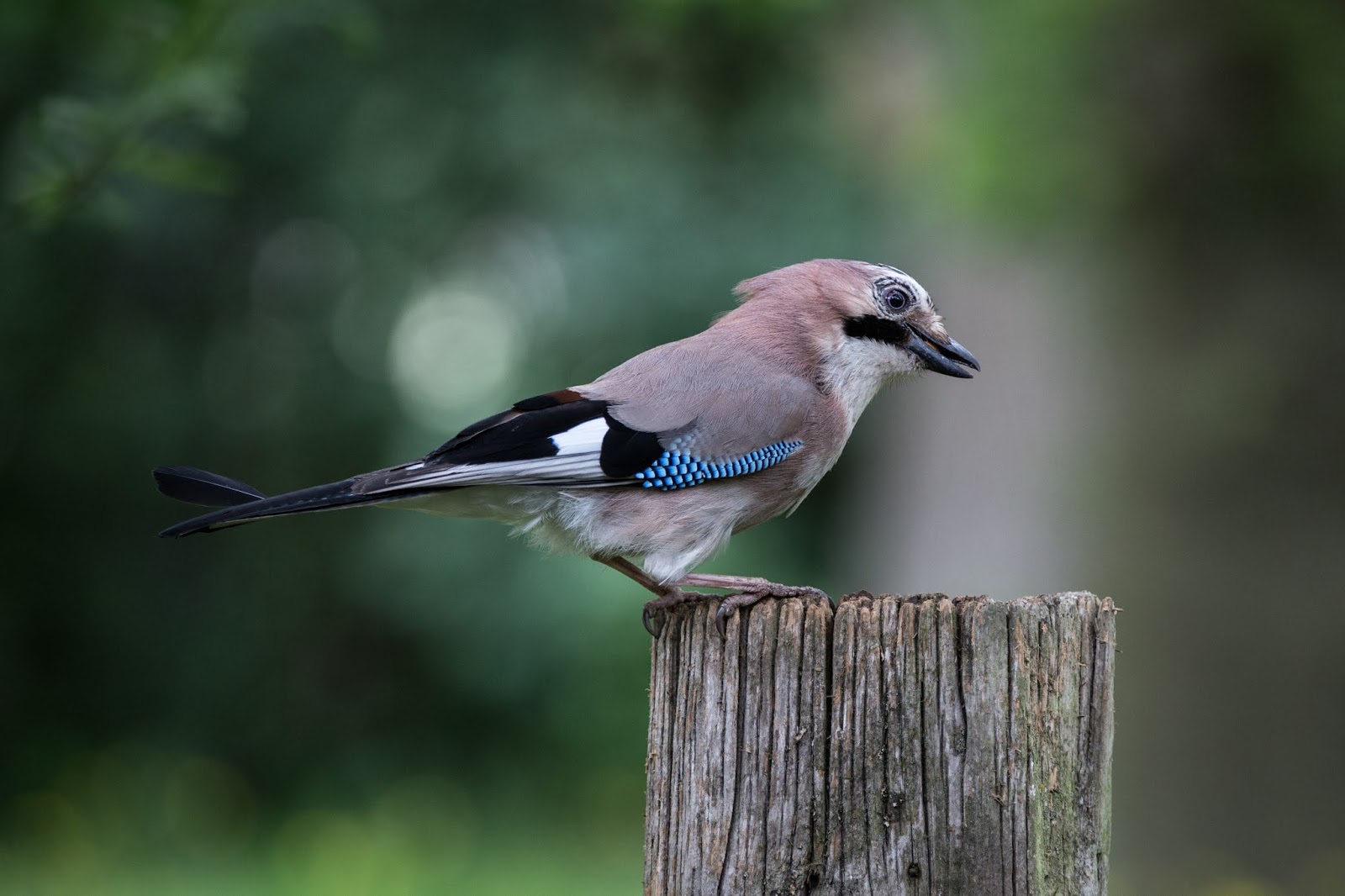
Jays in the garden


A pair of jays have been spending a lot of time in the garden.  One of them is usually to be found under the peanut feeder, waiting for a woodpecker to drop a shower of peanut fragments.  Even better is a whole peanut.


This is how a jay looks when all the peanuts have gone.

The jays had a nest in the top of a dead sycamore.  I didn't know it was there until I heard the commotion as it was attacked by a carrion crow.  I fear that the eggs or chicks didn't survive but at least the adults are still here.  The crows have been in my very bad books since I caught them chasing the sparrowhawk weeks ago and they know it.

Sunday, 7 June 2020

Mother springs a surprise on FoxCam

Trying to get video of the fox cubs on the trail cameras is very frustrating.  All four are still dashing around but they don't often appear together and don't produce many images worth posting.  This was an exception.  The camera struggles to cope with the high contrast in bright sunshine but I have adjusted it as much as I can and cropped it a bit so the image is not too bad. 


I generally prefer close-up images with the camera mounted low down for a more intimate view but that hasn't been a success with the foxes so I put the camera on a tree, without an additional lens, to get a wider view.  The parents rarely appear, probably because they know where the cameras are.  However, one day the vixen arrived at about 11am and as she turned round there was a surprise.


The day before at 1pm there were two cubs suckling.  The whole episode went on for over four minutes but I have cut it down to two.


The foxes' den is in an abandoned corner of the badger sett and although the badgers probably don't approve of their rather untidy neighbours they seem to get along OK.  I have occasionally seen the fox cubs sniffing round an entrance to the sett but only when there was no sign of a badger.  Here the vixen is exploring at 3 in the afternoon, apparently unaware of the camera and only a few minutes after mother badger had gone back inside.


I have also caught the dog fox on video once in the past couple of weeks.  He had one cub for company and brought out a dead crow for it to play with, although there was only this one clip.


The parents bring back food and leave it for the cubs to find and eat.  I have also seen a grey squirrel, a heron chick and another crow.  I expect the cubs are ranging farther afield now as they seem to be spending less and less time near my cameras.

Friday, 5 June 2020

An evening with BadgerCam

A bit more slow TV from BadgerCam.  This sequence runs for 15 minutes and nothing much happens but it shows what the badgers get up to when they first emerge in the evening.  Scratching, mutual grooming, socialising before going off foraging for the night.  It looks to be a very relaxed way of life.  The cubs are easily recognised, as is their mother with very pale fur (on the far right in the first photo).  There is a large boar and several medium-sized badgers.  Near the start of the video something spooks most of the badgers, apart from the mother.  I have seen that before - whatever panics all the others doesn't bother her.  They all look a bit sheepish when they re-emerge.  Only seven badgers in this sequence (I am not sure which one was missing) but all seven do appear together, briefly.  I hope you enjoy watching.


Wednesday, 3 June 2020

Out and about in May

The blog has been overrun in recent weeks by badgers, foxes and bees.  I have managed to get out for a walk for a few times so here is a summary of some of the things I saw last month in two local nature reserves, Weetslade Country Park and Banks' Pond.  First some dragonflies.

A male large red damselfly.

A male azure damselfly.

A teneral common blue damselfly showing almost no colour.

A male blue-tailed damselfly.

A four-spotted chaser.  I saw three at Weetslade but one was eaten by a reed bunting as I watched, so that was down to two.

A female broad-bodied chaser.


I found this unusual-looking bumblebee.  It is a hill cuckoo bumblebee (Bombus rupestris), also known as a red-tailed cuckoo bumblebee.  It is a social parasite of the red-tailed bumblebee (Bombus lapidarius).  It is a rare sighting for the county and probably only the fourth in recent times.  Note the very dark wings and the lack of a pollen basket on the tibia of the hind leg.


This is a red-headed cardinal beetle.

A female orange tip butterfly on Lady's smock, a favourite flower.

I heard singing from the reeds and was trying to decide whether it was a reed warbler or a sedge warbler when I caught sight of it.  It is a sedge warbler.

I have seen quite a few dingy skippers.  I don't know if they are more common this year or if I am better at recognising them.

I'll return to both reserves once or twice a month to keep an eye on the wildlife and post anything interesting here. Gosforth Nature Reserve reopened this week so I shall add that to the rota for June.

Monday, 1 June 2020

Leafcutter bee

The last time I saw a leafcutter bee's nest was 60-odd years ago in the handlebars of my brother's bike.  I have seen leafcutters in the garden here and I have found signs of their handiwork on rose leaves and raspberry leaves before but until yesterday I had never found one building a nest.  Time to get out the camera and take a few photos.


This is a female Megachile centuncularis, also known as the patchwork leafcutter bee.  The cells in its nest are lined with pieces of leaf, carried to the nest one by one.  I read on the BWARS website that the bee uses 6-14 pieces of leaf to line the walls of each cell and 6-7 discs to make a wall between each cell.  I didn't find where the leaf pieces were coming from but it was close by because the forays to collect the leaves were as short as 20s.


Sometimes the piece of leaf is longer than the bee yet she seems to fly with it quite easily.  I suppose it might be more difficult on a windy day.


It does seem to be a squeeze to get the leaf in sometimes but I think the way it is rolled makes it easier.


Like the red mason bee which featured here recently, and most other solitary bees, the cells are provisioned with pollen.  Also like the red mason bee, the pollen is carried on a scopa on the underside of the abdomen.  Here the scopa is full of orange pollen.

In the red mason bee nest all the pollen is yellow.  This bee, however, also collects white pollen,

and a mixture of yellow and orange.

Here is a female Megachile centuncularis, possibly the same one, visiting viper's bugloss (Echium vulgare) a few metres away.

All I need now are photos and video of it cutting the leaves.  I am working on it.