My Blog List

Friday, 14 April 2017

Bird of the week - Ring-necked parakeet


Well how about this for Newcastle wildlife?  I thought Bird of the Week was going to take a break but then I saw these birds at the weekend and couldn't resist sharing them.  These ring-necked parakeets are on the Town Moor in Newcastle upon Tyne.  I have previously seen them in London but this is the first time I had a decent view.  They are noisy and they fly fast, circling round and round and calling to each other.  They are a bit smaller than magpies.


For those of you who haven't been here, the sky is always this colour in Newcastle!  (I wish.)

The ring-necked parakeet (Psittacula krameri) is also known as the rose-ringed parakeet.  The adult males have a black and red neck ring but I couldn't see any on the birds I was watching.  I suppose it is possible this was a hen party or that these are immature birds.  They are long-lived and usually don't breed until they are three years old.  Perhaps the mature birds are already paired and nesting.  I read that feral parakeets are often hybrids between different subspecies of Psittacula krameri but I don't know whether this would affect their colouration.  These two below were engaged in what looked like courtship behaviour (known as a beak-lock) and I would guess the upper bird is a male. Looking at them I can't tell them apart.


These are fairly shy birds so I hid in the shade of a fence with overhanging ivy.  With a strong sun in their eyes I don't think they could see me.  One bird came and sat directly above me.  This made photography very difficult and gave me a crick in my neck.


At one point I could see eight birds at the same time and hear others in the trees behind me.  Here are six in the same frame.

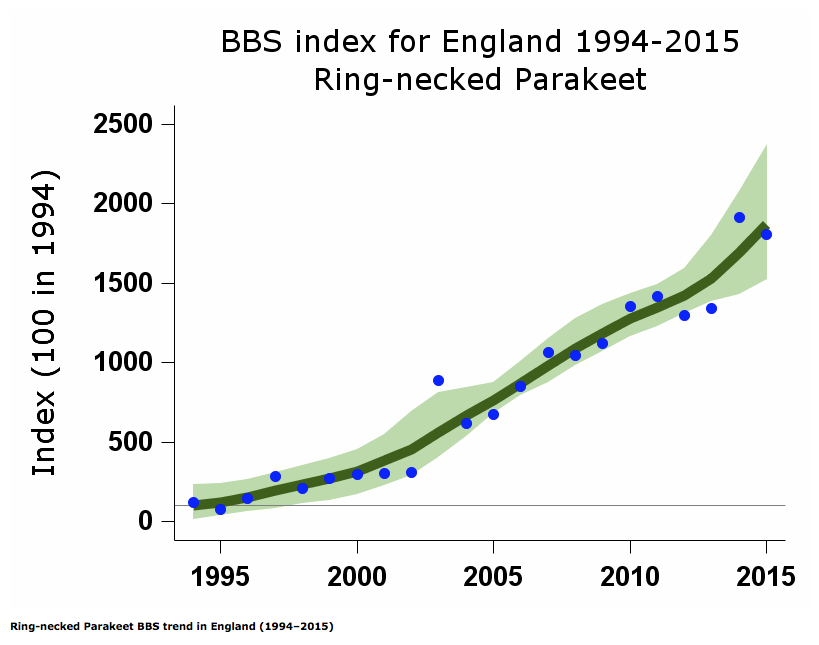
Ring necked parakeets have been feral in the UK for quite a few years but are mostly in the south east.  One story I read is that the UK population was started by birds that escaped from Ealing Studios after the filming of The African Queen (1951) starring Humphrey Bogart and Katherine Hepburn.  Other stories are that they were released by Jimi Hendrix in Carnaby Street in the 1960s or that they escaped during the Great Storm of 1987.  The population boom didn't start until the 1990s and there are now estimated to be over 20,000 birds in the UK.  I don't know how long these birds have been in Newcastle.
Ring-necked parakeets are still found mostly in the south east and London but these BTO Bird Atlas maps show their distribution.


You can listen to Sir David Attenborough's BBC Radio 4 Tweet of the Day here.  And watch a few short BBC Nature videos on parakeets with Chris Packham, Bille Oddie and Sir David Attenborough  here.

Wednesday, 12 April 2017

On a different scale


I went back to see the adders again.  Since last month the males have moulted and they now look at their best in shiny new black and silver skins.  I saw six males and two females basking in the sunshine.  When I first arrived on a cold, calm sunny morning there was none to be seen but they soon appeared as the sun warmed up.  They spent an hour or two heating up before slithering off to do whatever adders do in the day (which often isn't much).  I first found this male below.


Less than a metre away was this one, and another went past in the grass without joining them.

Farther on there were three more.


Both females I saw were very shy.  I could see a coil or two of each but no head or tail.


I also found a snakeskin, in almost exactly the same place as the one I found last year.  As I did last year I'll send it to the Wildlife Trust who collect shed adder skins for DNA analysis.

The skin was tangled in the grass and I think the snake does this deliberately to help pull it off. The skin stretches as it comes off, and is therefore longer than the adder, but also contracts a bit as it dries.  This one measured 40cm.  This is the dorsal surface, inside out.


This is the ventral surface.

This where they meet on the side.

This is the pattern on the back of the head.

And this is the head end where moulting starts.  I'd love to see it happening.

Monday, 10 April 2017

Return to Badger Bridge


I took the camera back to the badger bridge and this time positioned it at the end, looking along the log.  More than half of the photos were of the wrong end of the badger but a few worked out.  As before, I think there is more than one individual in these photos.


Saturday, 8 April 2017

Bee of the week - Tawny mining bee


These wonderful solitary bees are on the wing just now.  They are female tawny mining bees.  I don't know who chose the common name for this bee but "tawny" mining bee seems to be underselling it.  Tawny means yellowish brown or orange-brown but when you see this bee in the sunshine it is a vivid orange and looks like a glowing spark from a bonfire.


The males are smaller, slimmer and less brightly coloured.


The tawny mining bee is Andrena fulva and it is fairly widespread in lowland parts of England & Wales.  We do see it up here in the North East but these photos were taken in the churchyard of the 12th century Church of St Peter & St Paul in Nether Heyford in Northamptonshire.  Fifty years ago I used to ring the bells there but now I spend time crawling round the churchyard photographing bees.

In the churchyard there are dozens and dozens of tiny soil volcanoes, each one being the entrance to an underground bee nest.  I guess one reason the bees have chosen this spot is because the soil is sandy and the ground has been undisturbed for many years, probably for centuries.  The bees may have been there for hundreds of years as well.


The main shaft leads to four our five side burrows, each ending in a single cell which will produce one bee.  A female might make two or three nests in a season.  These females are returning with pollen loads on the scopa, the brush of hairs on the tibia of the hind leg.


The bees often pause for a rest after returning from a foraging trip and before going underground.


The male bee's only interests in his his short life are sipping nectar and mating.  Males can mate more than once (unlike male honey bees) but the females aren't interested once they have mated - they have enough to do digging the nest, collecting pollen and laying eggs.  That doesn't stop the males trying but this one was out of luck.


You can find a BWARS information sheet on Andrena fulva here.


Bee of the week has taken over from Bird of the week for a while - I don't know how long I'll keep it up.  My plan at the moment is for TrogTrogBee to stick to honey bees and for all other bees to stay on this blog along with all my other wildlife photos, although that may change.