My Blog List

Showing posts with label Waxwing. Show all posts

Sunday, 17 December 2023

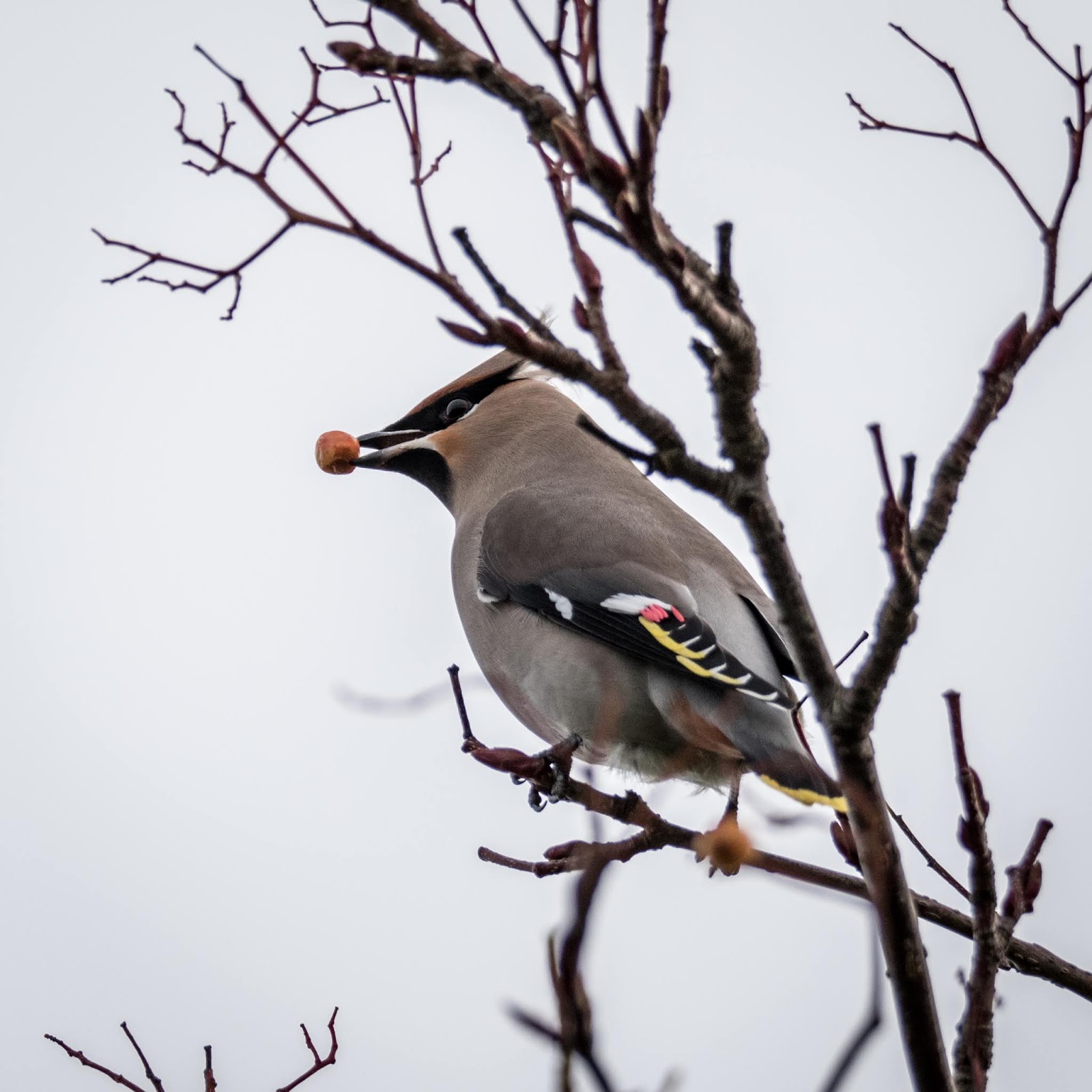
Bohemian rhapsody


This is already a "Waxwing Winter" with large numbers of these Fennoscandian birds having arrived in the autumn and now being seen right across the country.  When they first appeared I didn't join the throngs of observers as I have photographed them before and even saw them in my garden in my first winter here.  Nevertheless, when I received a tip-off from my friend Tim W about 200 Bohemian Waxwings at the end of my road I thought I should take a look.  I walked along the road about an hour after sunrise yesterday to find no sign of them but within a few minutes the flock turned up.  They sat high in some ash trees and swooped down to the hawthorn berries in the hedge below for 10 minutes or so, then circled a few times before flying off to the east.


I still have plenty of cotoneaster berries so there is a chance they may visit my garden this winter.

Saturday, 1 December 2018

Bird of the week - Waxwing

This bird is perhaps our most beautiful winter visitor, and is certainly highly prized by wildlife photographers.  I joined the throng outside Ashington Police Station yesterday to take these photos.  There were a few Sorbus trees with remaining berries and a dozen waxwings (Bombycilla garrulus) were there to finish them off.


It was a cold, windy cloudy day and the photography was very challenging, with the birds silhouetted against a white sky.  These were the best I could manage.


Waxwings breed in Fennoscandia and the numbers arriving in the UK vary enormously from year to year.  2016/17 was a great winter for them but numbers so far this winter have been small.  Waxwings spread south and west across the country as they eat the berries and can be found almost anywhere.  They favour Sorbus berries and can often be found in urban settings.  This map is from the BTO Bird Atlas Mapstore.

The waxwing is known as the Chatterer in Thomas Bewick's A History of British Birds.

Bewick wrote

Our Bohemian waxwings also occur in North America and were painted by John James Audubon in Birds of America - he called this bird the Bohemian Chatterer.  Incidentally, Audubon met Bewick in Newcastle in 1827.  I am sure they had a lot to talk about.  Audubon was 32 years younger and Bewick died the following year at the age of 75.

Archibald Thorburn made this study of waxwings in 1924.

You can listen to the waxwing's trilling call here.  And listen to John Aitchison's BBC Radio 4 Tweet of the Day on waxwings here.

Monday, 14 November 2016

Waxwings


This has already been a better winter for waxwings than the last two.  These birds are our most eagerly awaited autumn visitors and this year there are plenty.


I joined the crowd on the front lawn of Ashington police station to watch a flock of 50 or more birds.  They would fly in to the topmost branches of a nearby tall tree and sit there for a while trilling and preening.  Then suddenly they all swooped down to the rowan tree and grabbed as many berries as they could within a minute or so.  Then back up to the tall tree for a rest and more trilling and preening.  The whole process was repeated many times.  You can listen to a waxwing call on the RSPB website here.


Saturday, 12 December 2015

Bird of the week - Waxwing

Waxwings must be our most exotic and beautiful winter visitors.  To look at them you'd think they came from the tropics rather than Scandinavia and northern Russia.  These birds were a group of four in the sunshine in Jarrow this week. (My friend and namesake Jack tells me Jarrow is pronounced Jarra.)  Unfortunately they were feeding on berries in deep shade making photography very difficult.


The waxwing is named after the small red dots on its wings which resemble spots of sealing wax (it was obviously named a long time ago).  Its scientific name Bombycilla garrulus means chattering silktail.

The number of visiting waxwings varies enormously from year to year.  So far this year there have been only a few but there have several sightings locally, usually of one or two or a handful of birds.  This is the current BirdTrack reporting rate graph for the UK.

This year's berry crop is also small so when the birds have eaten them all they'll move off south and west.  If, like me, you are not on Twitter, you can check the latest waxwing sightings on Twitter here.  And you can listen to the BBC Radio 4 Tweet of the Day on waxwings here.