My Blog List

Showing posts with label Dunstanburgh. Show all posts

Tuesday, 17 September 2019

Robin's pincushion

I have seen much more Robin's pincushion recently than in previous years but until now nothing like this.  We came across this rose bush on a coastal walk just north of Dunstanburgh castle and it is smothered in galls.

They are caused by the tiny bedeguar gall wasp Diplolepsis rosae.  It lays its eggs in leaf buds on wild rose, causing the development of a gall in which the larvae feed, grow and shelter, emerging next spring.


Over 99% of the larvae are female, being produced by parthenogenesis.  The females are infected with a bacterium, Wolbachia, meaning they can only produce diploid eggs, hence female offspring.  Female wasps treated experimentally with an antibiotic can produce haploid eggs and male offspring!


The Robin in the name was Robin Goodfellow, a woodland sprite in folklore.  He was also known as Puck or Hobgoblin.

Saturday, 9 July 2016

Bird of the week - Razorbill

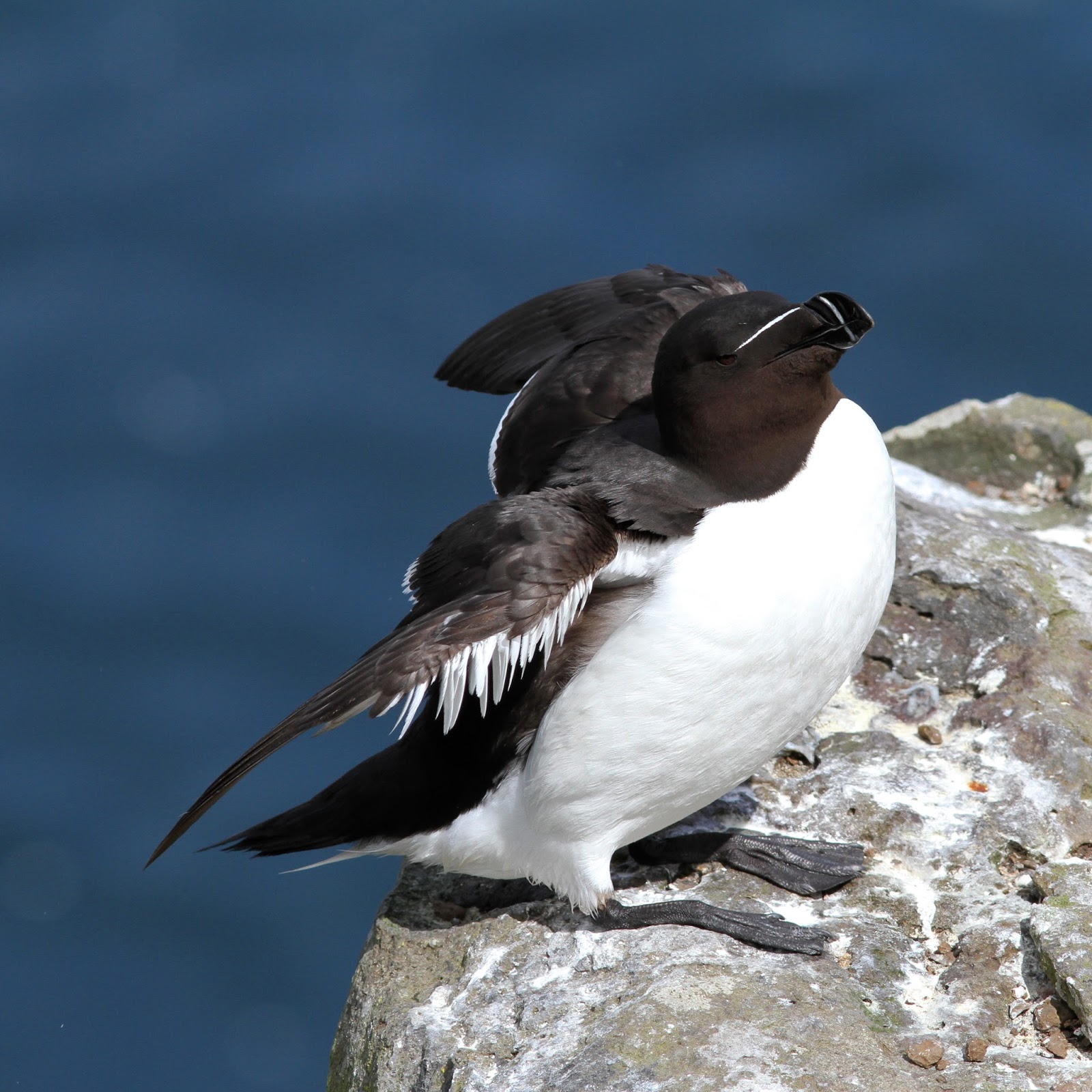
Razorbills spend most of their lives at sea but visit land in the spring to raise their young.  These photos were taken on the cliffs at Dunstanburgh Castle.


The razorbill has a curious layer of feathers under the leading edge of its wings.  I presume this is an adaptation to underwater swimming rather than flight.


I couldn't see many chicks from the top of the cliff.  This one was closely guarded by its parents.


Thomas Bewick wrote about the razor-bill (Alca torda) in A History of British Birds, vol II, published in 1832.  In his day there was no digital photography so, if you wanted a closer look at a bird, you had to shoot it.


Razorbill eggs were a valuable food source at that time although guillemot eggs were more frequently taken.

Eggs of razorbills and other birds were still being collected from the cliffs 100 years ago.


You can watch a film made before the First World War of "climmers" on the cliffs at Flamborough Head on the Yorkshire Film Archive here.  Razorbills and their eggs are still hunted and harvested in Iceland.

Razorbills are found on northern and western coasts of the British Isles and of Europe.


Razorbills make a curious groaning or growling noise which you can hear here.  Listen to the BBC Radio 4 Tweet of the Day on razorbills here.

Thursday, 28 August 2014

Swallows at Dunstanburgh Castle

Because we were walking from Craster to Low Newton and back I took only a pocket camera.  I did at least manage these pictures with the Panasonic TZ20.  The moral is always always take the Canon.