My Blog List

Thursday, 11 March 2021

Stocktaking

Wow.  This was exciting.  I heard a crash on the roof and when I looked out of the study window I saw a cloud of feathers and a fight going on.  A female sparrowhawk had taken a stock dove off the roof.  I ran for a camera and these were the first images, taken from about 1.5m.

The dove was still very much alive at this stage and I thought it might get away (it is heavier than the sparrowhawk - 300g v 250g) but the sparrowhawk had a firm grip.  I could hear a lot of commotion from jackdaws and crows who were presumably unimpressed by having a serious killer in the garden and the sparrowhawk was mantling (shielding her prey from other birds).  I think she couldn't see me because of the reflection of the sky in the window.


Eventually the dove succumbed (I have spared you the gruesome photos) and she dragged it off into a corner where I couldn't see it.  I managed to ease open the bathroom window slightly and changed to the Panasonic TZ90 which has a small lens and a silent shutter - the sparrowhawk was again about 1.5m away and this time I think she knew I was there.

Eventually she moved a bit and I moved a bit and I could get some better pictures.


Then she dragged the dove under the front of the car and out of my view.  I waited until nearly dark before going out and this was all that was left.


According to Ian Newton's book The Sparrowhawk (1986), a female sparrowhawk can eat up to 55g of meat in one sitting (20% of her body weight), so with a kill such as this it is not surprising that she concentrates on the breast meat, the flight muscles.  A female will eat about 22kg of meat in a year, and so needs a feed such as this on average once a day.  A pair of sparrowhawks will consume the equivalent of 2,200 sparrows or 600 blackbirds or 110 wood pigeons in a year - sounds a bit like a Henry VIII banquet.

It is tough on the stock dove but that's what sparrowhawks do.  And this is what a stock dove looks like when it is not being eaten.  Ironically, this photo was taken earlier in the same day on the (male) sparrowhawk's perch.  It may even have been the same bird.

Tuesday, 9 March 2021

OtterCam in the culvert


After a couple of weeks of dry weather the water level has fallen sufficiently for me to put a camera in the culvert again. This is good news because since the mother and cub split up there has been noticeably less otter activity in my recent site on the bank - the camera there is now mostly recording rat videos.  The camera in the culvert, on the other hand, is picking up an otter once or twice a night - 12 traverses in the first 5 days in fact.  The challenge is to decide whether it is all the same animal or whether there is more than one.


All solo otters look pretty much alike on slightly blurry freeze-frame stills from videos so I tried to standardise the pictures with the animal the same distance from the camera on the clearest few videos and it looks like this in date order (no 4 was already a bit closer at the start of the clip).


My impression is than nos 1, 3 and perhaps 5 are a bit bigger than nos 2 and 4.  It isn't easy because 1, 3 and 5 trot confidently past the camera whereas 2 and 4 seem to be trying to slink past without being seen.  But that in itself might be a significant difference.

It is more difficult when they are going the other way.  They are more inclined to run or bound through, perhaps because going against the water flow in a slippery pipe is more difficult, and the camera is sometimes a bit slow to pick them up.


Here is a video composite.  Of the retreating animals, the last one does look bigger.

In the second week the water level had dropped further so I was able to clamp the camera a bit lower down as well. Otters continued to use the pipe twice each night on average.  One intriguing finding was two recordings 10 minutes apart, both heading south.  The first animal is bigger and confident and the second is lower and again slinks past the camera so I am fairly convinced these are two different otters.  I don't know if the first is a dog and the second a female or the first an adult and the second last year's cub.  Either way I expect the first is male and the second female.


As long as it is safe I'll keep the camera in the culvert for the time being, although I think it will be a few months yet before we see more cubs.

Saturday, 6 March 2021

Sparrowhawk news


Not much news really, but an opportunity to share a few more photos.  The sparrowhawk has been here a lot in the past two or three weeks and has spent more time sitting on the perch.

I am still unsure how many sparrowhawks are visiting the garden but, especially having seen the tail-fanning display a couple of weeks ago, I do think there may be more than one.  A few days ago this bird was here early.


At lunchtime on the same day this one was here.  Judging by the scratch marks on its upper mandible and the white patches on the cere (the waxy yellow structure at the base of the mandible) it is probably the same bird.
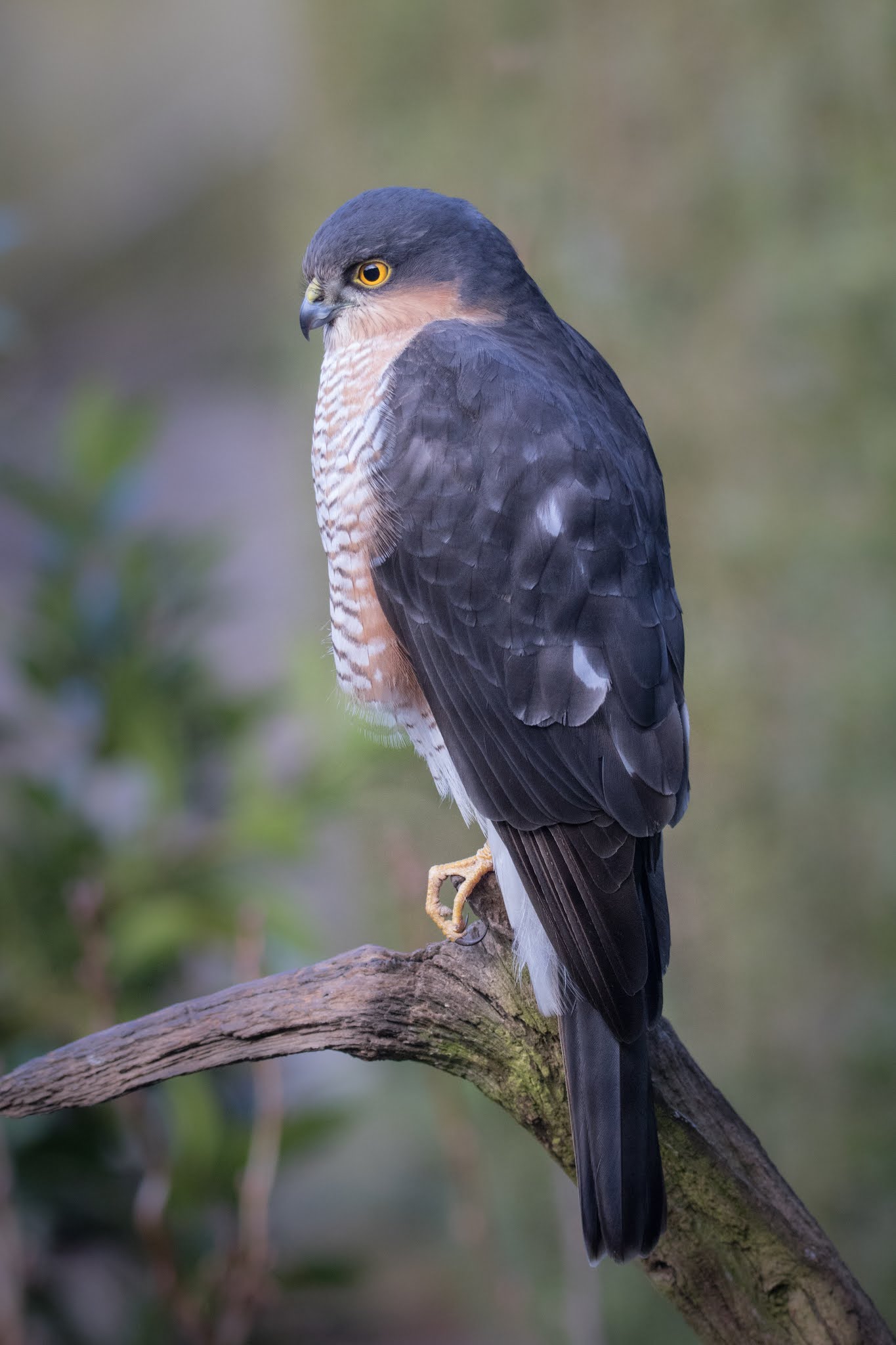

But late that afternoon I saw this one.  The front edge of the cere looks different and the scratches on the beak are not there.  It also has more pinkish colouring between the eyes and less pink on the breast, although feathers move around and can look different.


Two days later this bird in late afternoon, with a different appearance to the cere again.

Two days later again this one in early morning which I think is back to the first, including the scratch marks.


It may be that these are all the same bird but to me they look different.  I enjoy which ever one turns up, even if it is all the same one.  When he was here yesterday I was able to photograph his tail feathers, showing the retained juvenile feathers with frayed edges as well as new feathers from his first moult last summer, which I first noticed during the tail-fanning.  This may be another way of distinguishing individuals.  I'll look out for it at each opportunity.

Here are a few more recent photos, possibly not all of the same bird.


Wednesday, 3 March 2021

WoodcockCam


Another bonus from the trail cameras.  This time, pictures of woodcocks.  I had the impression I had seen more than usual this winter and the cameras have picked up these two in the past two weeks.


Woodcocks are very shy, beautifully camouflaged and crepuscular so if you see one at all it has seen you first and is usually flying away from you.

My impression of higher numbers this winter is borne out by the data in BirdTrack.  Here is 2021 (green line) compared with the long-term average for the British Isles (red).


And this is the same for Northumberland, with February 2021 numbers almost ten times higher than the average.

The woodcock is a British resident with perhaps about 50,000 breeding pairs but about 10 times more in winter, so most of these birds are visitors from northern Europe.  I once came across a woodcock nest in Teesdale.  These are the beautifully marked eggs.

I also once saw a woodcock in the garden but didn't get a photo.  It would get onto my garden list, if I had one!

Monday, 1 March 2021

Double strike

I heard a fearful bang on the kitchen window early this morning.  When I went out to see what had hit it I found two very stunned tree sparrows lying on the ground.  I picked them up to keep them warm (and to take their photo) and in less than ten minutes they were fit to fly.

Despite there being lots of birds in the garden and lots of windows in the house I don't get many bird strikes and fortunately they are rarely fatal.  Often the trigger is a sparrowhawk attack, in which case the attacker knows to pick off the stunned prey before it can fly away.  This is the first double strike I can remember.

Thursday, 25 February 2021

OtterCam in February


Since the mother and cub split up it has been hard to tell which otter is which, or indeed, if there is even more than one. The resident female is probably still here, the dog may still be around or calling in, and the cub could still be hanging around in the territory.  Although the videos are not the best, one of the cameras picked up some intriguing behaviour last week.

On the first night an otter ran up the bank and clearly has a mark on its flank - possibly from an injury.

Four hours later another otter turned up.  It spent a few minutes rolling around on the ground (often slightly out of view so I have edited the footage) and clearly doesn't have a mark so this is a different animal.  I am not sure if just has an itchy back and is conditioning its fur or whether it might also be scent marking.


Much later that night the otter with a mark on its flank ran up the bank again and didn't return the same way.


The next night the unmarked otter returned and was rolling and scratching in exactly the same spot (again I have edited the video) before running up the bank.


And a couple of hours later an otter came down and spent some time sniffing in the same spot.


On the third night an otter came down the bank and spent several minutes rolling and grooming before slipping into the water.


I think this is evidence that there still are at least two otters around and my guess is that the big animal that has been rolling around is the male.  Otters do condition their fur by rolling like this but it could also be a way of marking the territory.

Here is another video from earlier in the month of the otter rubbing itself on the ground and grooming its fur before getting back in the water.

And one brief video left over from when we had the snow.  I had been hoping for a recording of an otter in snow but when it turned up the lens was covered in snow so the picture quality is poor.  Maybe next winter.