
Wednesday, 8 April 2020
Peek-a-boo
Another recent photo from the Wingscapes BirdCam 2.0. Reynard and Brock peering at each other round the tree. I wonder which was more surprised?


Monday, 6 April 2020
KingfisherCam

Another big surprise on one of my trail cameras. I have never seen a kingfisher on the ground before. Their tiny feet are adapted to perching on reeds and excavating nest tunnels but this one seemed quite comfortable standing on the mud. As far as I can tell it is a mature adult male (bright orange feet and all-black bill). In the last clip you can see it streaking off down the stream, often the only view you get of a kingfisher.
Saturday, 4 April 2020
BadgerCam in colour
Here are a few recent badger photos from the Wingscapes BirdCam 2.0 trail camera. Unlike foxes, badgers are quite happy to sit for a series of photos, especially if tempted to loiter in front of the camera by a few peanuts. The first night I put the camera in they were very wary and hurried past (I could see on an infrared video camera alongside) but within a couple of nights they seemed quite used to it.
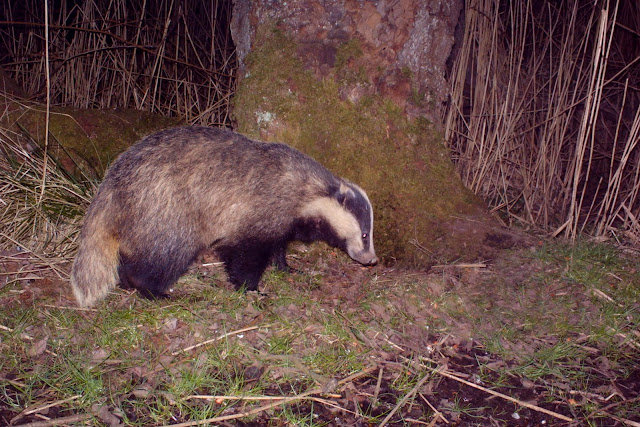


I wonder why some badgers look muddy and dusty


while others are able to keep themselves smart. I suspect it is the males who look scruffy while the females take more care over their appearance. Just a theory.


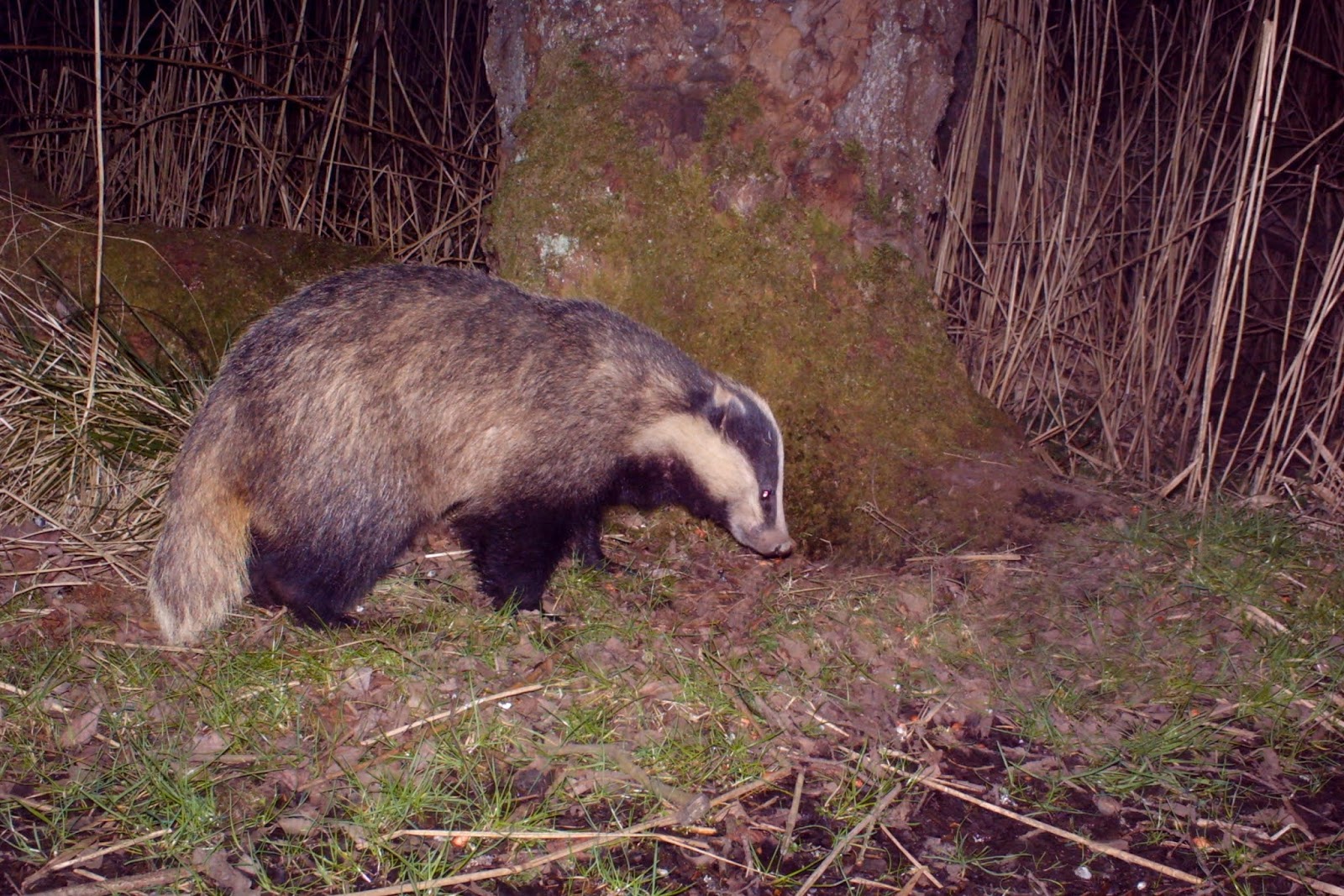


I wonder why some badgers look muddy and dusty


while others are able to keep themselves smart. I suspect it is the males who look scruffy while the females take more care over their appearance. Just a theory.


On this outing the camera performed really well, taking about three dozen photos over three nights. The badgers don't seem to mind the flash at all but they don't always stand in the right place and smile at the camera.

Thursday, 2 April 2020
The reserve in March
Gosforth Nature Reserve is only a mile from my home as the sparrowhawk flies. Being often busy in the reserve with work parties, education visits, etc I usually spend less time looking and watching than I should, so my plan for this year was to post a monthly review from now until at least the end of autumn on things I see there. Unfortunately the reserve is now closed and won't reopen until the movement restrictions are lifted but here at least are some of the things I saw in March.
Herons regularly nest on top of some tall Scots pines in the northeast corner of this reserve but this year two pairs have built nests much closer to the lake. I think both parents must share the work of incubating the eggs as I watched the change over between these two.


I saw and heard the first chiffchaffs of the year. Our first summer visitors, just in from Africa.

I expect mallards are already nesting. A gang of males was wandering around looking very handsome while the females were probably hidden away incubating their eggs.

The changes in colour as the mallard turns its head are amazing.


Two species of geese nest in the reserve. Greylag geese are native but most are descended from reintroductions after they were almost wiped out by wildfowlers.

Canada geese are non-native but widespread in the UK. In smaller areas they can be real pests but the few here are not too bad.

A large gang of black headed gulls have been established on the lake for a few weeks. They nest on a platform in the lake built for common terns (which haven't yet arrived back from Antarctica). They have been busy mobbing the herons and any other birds they don't like the look of.

The alder trees were in flower. The male catkins dangle in the wind below the small red female flowers which will produce cones later in the year. the alder is our only deciduous cone-bearing tree. Alder wood was used to make the foundations of Venice and more recently has been used to make the bodies of Fender electric guitars.


Hazel trees were also in flower. Hazels are monoecious, meaning they have separate male and female flowers on the same plant. The male catkins are very obvious.

The female flowers are tiny. These two have already been pollinated and are starting to swell to form hazel nuts.


This fungus caught my eye. It is Sarcoscypha coccinea, the scarlet elf cup. It grows on decaying sticks and branches in damp areas, something we have plenty of.


With no people in the reserve the animals will be having a marvellous time. Who knows what they will get up to with no-one watching?
Herons regularly nest on top of some tall Scots pines in the northeast corner of this reserve but this year two pairs have built nests much closer to the lake. I think both parents must share the work of incubating the eggs as I watched the change over between these two.


I saw and heard the first chiffchaffs of the year. Our first summer visitors, just in from Africa.

I expect mallards are already nesting. A gang of males was wandering around looking very handsome while the females were probably hidden away incubating their eggs.
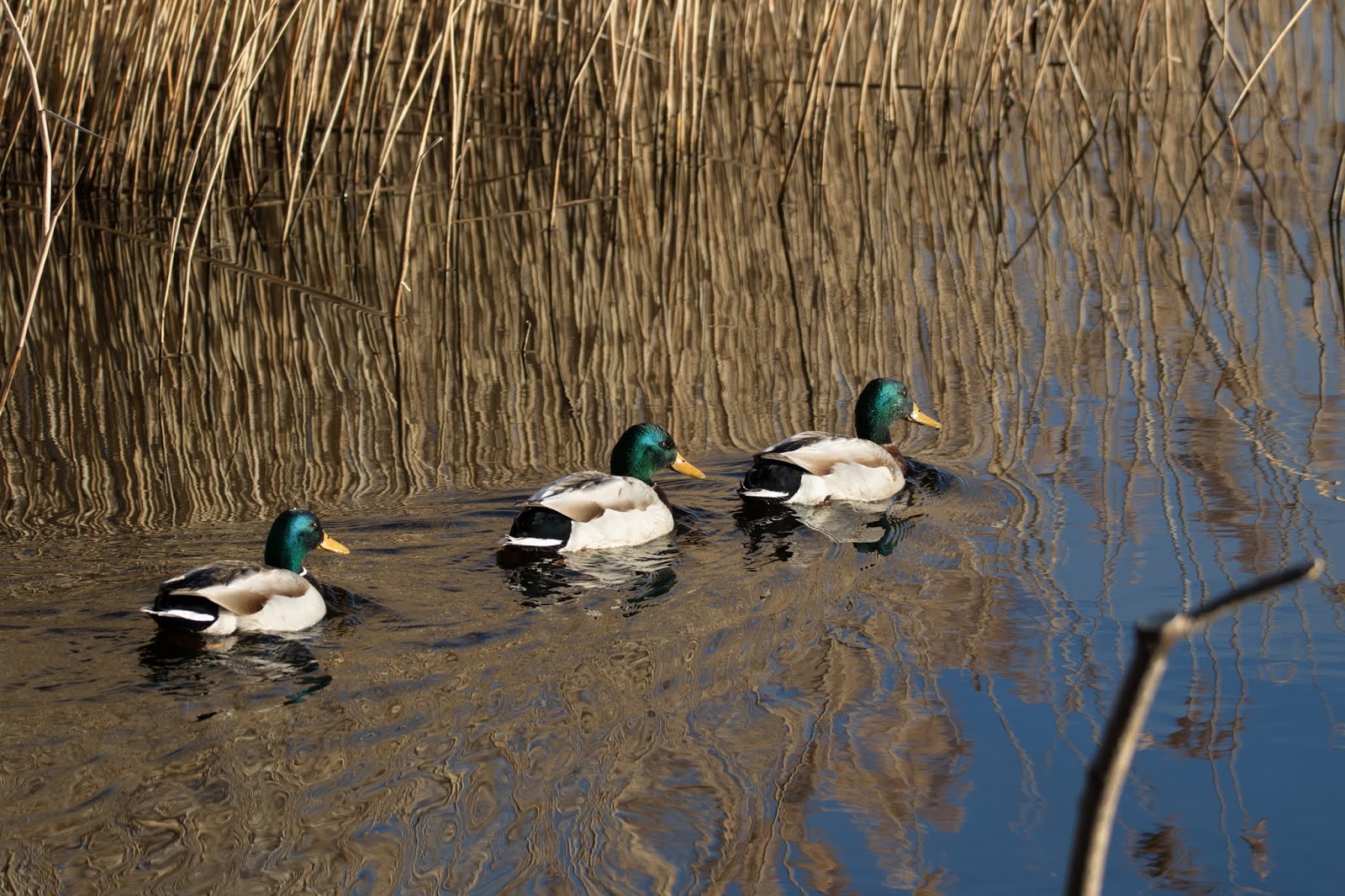
The changes in colour as the mallard turns its head are amazing.


Two species of geese nest in the reserve. Greylag geese are native but most are descended from reintroductions after they were almost wiped out by wildfowlers.

Canada geese are non-native but widespread in the UK. In smaller areas they can be real pests but the few here are not too bad.

A large gang of black headed gulls have been established on the lake for a few weeks. They nest on a platform in the lake built for common terns (which haven't yet arrived back from Antarctica). They have been busy mobbing the herons and any other birds they don't like the look of.

The alder trees were in flower. The male catkins dangle in the wind below the small red female flowers which will produce cones later in the year. the alder is our only deciduous cone-bearing tree. Alder wood was used to make the foundations of Venice and more recently has been used to make the bodies of Fender electric guitars.


Hazel trees were also in flower. Hazels are monoecious, meaning they have separate male and female flowers on the same plant. The male catkins are very obvious.

The female flowers are tiny. These two have already been pollinated and are starting to swell to form hazel nuts.


This fungus caught my eye. It is Sarcoscypha coccinea, the scarlet elf cup. It grows on decaying sticks and branches in damp areas, something we have plenty of.

With no people in the reserve the animals will be having a marvellous time. Who knows what they will get up to with no-one watching?
Tuesday, 31 March 2020
FoxCam in colour
I don't use my old Wingscapes BirdCam 2.0 very often these days as it is a bit unreliable and often disappointing. Over the years I have had four but only one still works. Its advantages are that it has adjustable preset focus and takes proper flash photos, giving colour night time still photos. The problem with the one that still works is that the sensitivity is too high on "high" and too low on "medium", meaning that it can miss a lot of photos. Every now and then, though, it can have a good night. I have been targeting badgers recently (more to follow) but also picked up a couple of decent fox photos which I thought you might like to see. These two were taken on different nights but are probably the same animal (it has the same mark on its nose). Unlike the badgers the fox doesn't hang around for a second photo.


Sunday, 29 March 2020
Sparrowhawk news

After almost a week of the lockdown here is a report from the garden. Since my last post a few weeks ago I have seen much more of the adult sparrowhawk than the juvenile. Over the past couple of weeks he has mainly been here in the afternoon. I suspect this is because he is catching extra food for his mate to get her into top breeding condition, rather than because he can't get enough to eat. (The female has to get to a weight over 320g, twice the male's weight, otherwise she won't be fit enough to lay eggs.)


On one afternoon he made and ate two kills within 30 minutes and then was so full he just sat under the gooseberries for an hour, almost as if he was too heavy to fly off.

The next morning he had a blue tit for breakfast.


An hour later he was eating a robin. He likes to stand on the edge of the raised bed as he can get a better grip on his prey.

A couple of days ago he caught me by surprise and I twice spooked him, not realising he was in the garden. Yet twenty minutes later he was eating what I think was a great tit. He is fastidious in cleaning his talons and his beak when he has finished.


In this photo he was sitting only about 1m from the window. It is a poor photo taken in deep shade but I like it because you can see the reflection of the window in his eye, even if you can't quite see me.

I have been recording a few videos with the window open, so there is an audio track. There is a lot of background noise from the traffic but you can also hear the alarms from the small birds in the gooseberry bushes. Don't worry, there are no videos of him feeding. In this one he is on high alert and is hungry.
In this clip he is happy to sit and preen after eating.
This video shows how the camera copes with changing light. To start with the perch was in shade with a brightly lit background. Then the sun went behind a cloud (or, more accurately, a cloud passed in front of the sun) and the camera automatically adjusted the exposure so the sparrowhawk appears brighter. Then the sun reappeared and the settings were reversed.
Here he launches three attacks. You can see how quickly his attention switches from preening to hunting. He didn't return to the perch immediately after any of these attacks but I didn't see whether they were successful.
Sometimes he gets a bit bored with the kitchen garden and flies over the hedge to try his luck on the feeders outside the kitchen window.
Here is a short video close-up recorded in landscape format.
The portraits work best in portrait format so here are a few from recent days.


In previous years the sparrowhawks have stopped visiting the garden around the beginning of April so he may not be around for much longer. If he does go I shall miss having him here but at least I shall be able to get on with some work in the kitchen garden.
Subscribe to:
Posts (Atom)