My Blog List

Monday, 6 March 2017

Sparrowhawk (again!)

I hope you don't mind a few more sparrowhawk photos.  On this occasion he seemed to have spotted something on the ground.  I couldn't see what it was - possibly a dunnock hiding under the hedge or a bank vole.


At one stage he ventured into the gooseberry bush for a closer look but he didn't mount an attack.

Then he moved to sit on top of the feeder.

Then on top of the hedge.  When he flew off I couldn't see if it was in pursuit or just to go somewhere else.

Saturday, 4 March 2017

Bird of the week - Yellowhammer


Here is a bird to gladden the heart in late winter.  Male yellowhammers are now starting to come into their glorious breeding plumage.  These males have very yellow breast feathers.


These males illustrate the variation in colouring.


The females and first winter males are much more subtly coloured.


The yellowhammer is Emberiza citrinella, meaning yellow bunting.  Thomas Bewick knew it as the yellow bunting - here is his engraving for A History of British Birds (1797).

Bewick wrote of the variability in colour of the yellowhammer:

He also wrote

In his day the yellowhammer was a common bird.

Like so many birds of arable farmland the yellowhammer is now in trouble and is red-listed.  It is found in lowland areas of England, eastern Wales, eastern Scotland and eastern Ireland.


But it is in decline across most of its range.


Yellowhammers are native to Europe and northern Asia.
By Jimfbleak - Own work, CC BY-SA 3.0, https://commons.wikimedia.org/w/index.php?curid=32417243

In the 1860s and 1870s yellowhammers were introduced to New Zealand, supposedly to control insects eating crops planted by the settlers.  They were carried by ship and almost all survived the journey.  They cost 7/6 each (that's seven shillings and sixpence, or 37.5p if you are too young to know).  That's about £32 each in today's money!  Here is part of the receipt for 130 Yellow Hammers.  (They cost £48 15s 0d at the time and £4,160 in today's money so someone was obviously very keen on yellowhammers).  The shipment also included partridges, thrushes, blackbirds, goldfinches, redpolls, linnets  and starlings.

Not surprisingly the yellowhammers preferred to eat the crops and for a while were considered a pest.  You can read the story here.  Ironically yellowhammers are now faring better in New Zealand than they are in England.

Archibald Thorburn painted a pair of yellowhammers (the female looks a bit glum)

and a reed bunting with a yellowhammer.

Listen to the song of a yellowhammer here.  Listen to the BBC Radio 4 Tweet of the Day here.

Friday, 3 March 2017

Record shot

This great grey shrike has been at Prestwick Carr all winter but never comes close (at least when I am there).  This photo was taken from just over 200m away with a 600mm lens and a crop sensor, giving an effective focal length of 960mm.  I didn't have a tripod so I managed by propping the monopod against a fence post.  The first photo is uncropped, the second is a big crop of the same image.


So, just a record shot but I guess it is not bad considering - at least you can make out what it is.

Thursday, 2 March 2017

Nestbox news

I wrote a post recently about finding a nest in the camera box, not long after I thought I had cleaned out the remains of last year's blue tit nest.  However, I think I was mistaken and having compared the recent photos with the last ones from last summer I think I had overlooked this box when I cleaned out all the others.

I have kept an occasional eye on the box recently and the first bird I saw in it was a blue tit, a male.  He sat and looked around for several minutes, preening occasionally but otherwise just looking.


Then the female came in and they both spent some time looking around.  The male is on the right (brighter colours and more white on the back of his head).

Later I got a short video.  At first just the male is in the box.  Then his mate comes in and you can see the difference in colouration.

Having decided this was an oversight and not a new nest I cleaned out this box as well, so now we are back to square one.

Since then Mrs B-T has continued to keep an eye on things.


Mr B-T pops in from time to time as well.

I also heard a commotion outside the box one time and what looked like the tip of a starling's beak poking in the entrance (which is on the left as we look at it).  A few minutes later I saw a pair of starlings trying to get into this tree sparrow box below.  The entrance hole is too small for starlings but that didn't stop them trying.  The frightened sparrow was inside but eventually made its escape.


This is the male starling, with a blue base to his bill.


These two sparrows were keeping a close guard on their box while watching the starlings a few metres away.

Blue tits have also been challenging the ownership of this tree sparrow box.


In previous years the blue tits in the camera box have started bringing in moss in late March or early April so I guess at this stage they are just looking.  I'll let you know what happens.

Wednesday, 1 March 2017

Caught red-handed


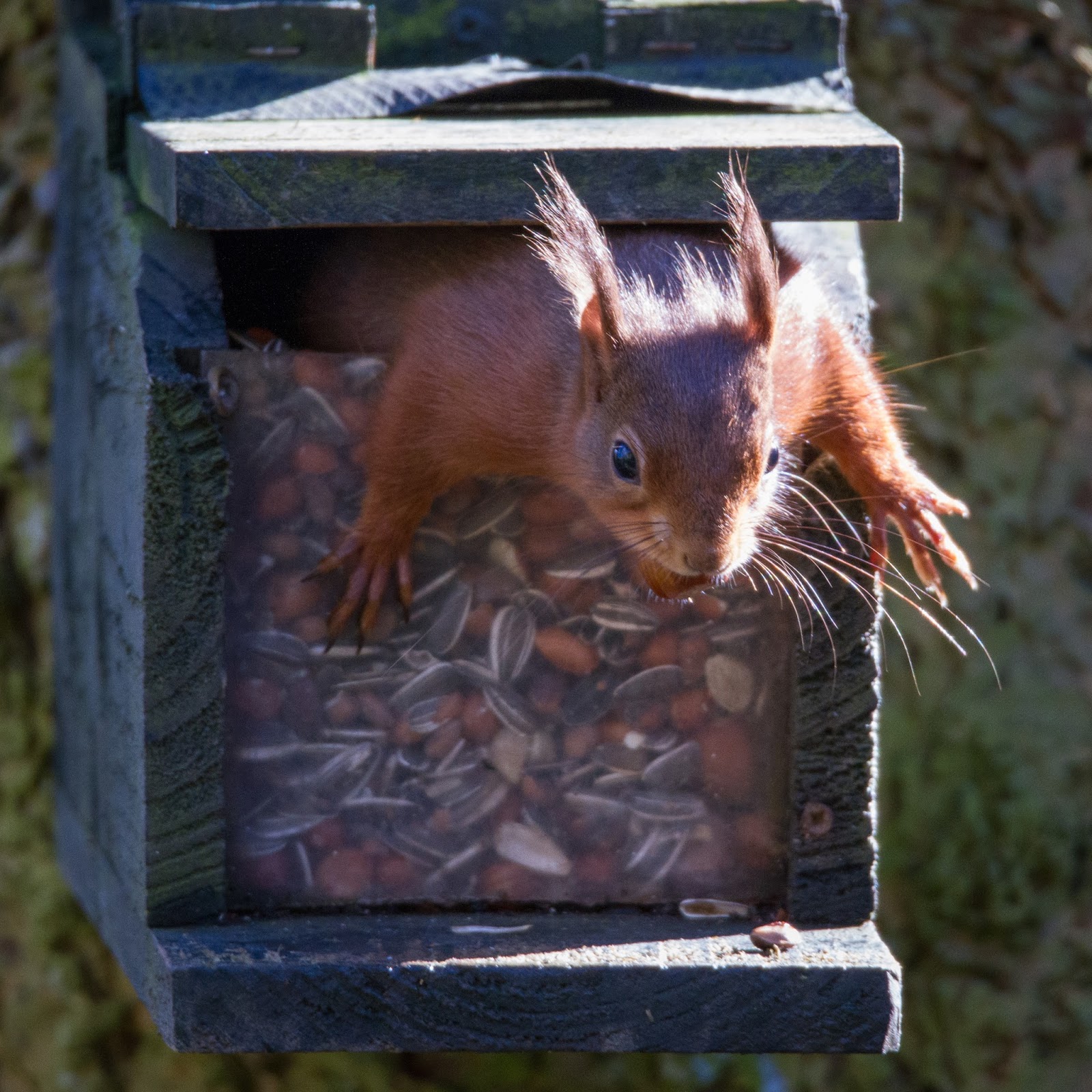
I expect you can guess the culprit.

He thought he would get away with it but he hadn't reckoned on my security camera.


He emerged red-faced but happy.  Who says crime doesn't pay?