The first snow of the winter. The squirrels looked as though their paws were cold. Mine were.
My Blog List
Monday, 14 December 2015
Saturday, 12 December 2015
Bird of the week - Waxwing
Waxwings must be our most exotic and beautiful winter visitors. To look at them you'd think they came from the tropics rather than Scandinavia and northern Russia. These birds were a group of four in the sunshine in Jarrow this week. (My friend and namesake Jack tells me Jarrow is pronounced Jarra.) Unfortunately they were feeding on berries in deep shade making photography very difficult.
The waxwing is named after the small red dots on its wings which resemble spots of sealing wax (it was obviously named a long time ago). Its scientific name Bombycilla garrulus means chattering silktail.
The number of visiting waxwings varies enormously from year to year. So far this year there have been only a few but there have several sightings locally, usually of one or two or a handful of birds. This is the current BirdTrack reporting rate graph for the UK.
This year's berry crop is also small so when the birds have eaten them all they'll move off south and west. If, like me, you are not on Twitter, you can check the latest waxwing sightings on Twitter here. And you can listen to the BBC Radio 4 Tweet of the Day on waxwings here.
Wednesday, 9 December 2015
Mr & Mrs GSW
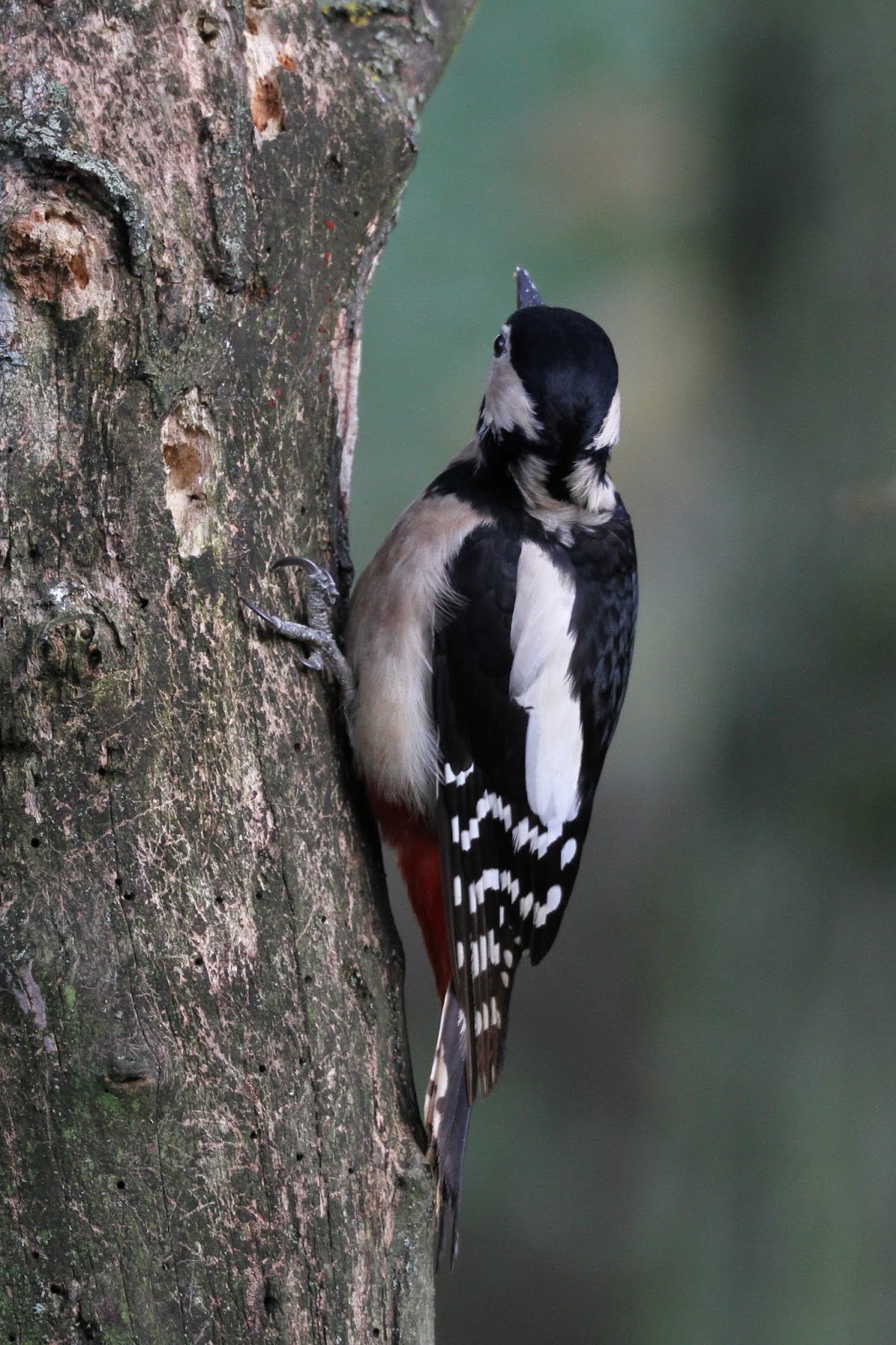
When I put up this type of feeder last winter more than 99% of the visiting great spotted woodpeckers were males (for reasons I can't explain). I put this one up at the weekend and the first bird to visit was a male (there is a slight variation in colours as the sun was going in and coming out)
but minutes later there was a female..
Since then it has been all males again. The only difference this winter is that the feeder is a complete trunk going down to the ground rather than a short section sitting on the bird table. It will be interesting to watch what happens over the next few weeks.
Monday, 7 December 2015
Scarlet lily beetle
I found this little beast in my small patch of woodland this morning. I'm not sure what it was doing out and about in December or, for that matter, why it is here. It is a scarlet lily beetle (Lilioceris lilii) and eats lilies, of which I have none in the garden, and fritillaries (I have a few - or at least I had last time I looked). It is distinguished from the slightly larger cardinal beetle (Pyrochroa serraticornis) by its black head, its shiny and dimpled wing cases and its non-toothed antennae.
Saturday, 5 December 2015
Bird of the week - Short-eared owl
The short-eared owl (Asio flammeus) is a top bird and attracts a lot of attention in autumn and early winter. It is the most accessible British owl as it flies in the daytime while hunting for voles.
It has been a good season so far for short-eared owls locally, with birds flying at many points up the North East coast. This graph shows the BTO BirdTrack reporting rate for the UK this year.
The breeding population is small and is mainly confined to northern uplands but in winter the population is swelled by migrants from Scandinavia and northern Europe. The maps are from the Bird Atlas.
Listen to the BBC Radio 4 Tweet of the day on short-eared owl here. Read more about short-eared owls here. Watch a BTO video on short and long-eared owls here.
Friday, 4 December 2015
Grounded
Wednesday, 2 December 2015
Hibernation at last
Last winter my hedgehog stayed up and didn't bother to hibernate. After the cold weather of the last week or so I think it has decided enough is enough and has turned in for the winter. I haven't seen it for a week and although the food I put out is eaten, it is not by the hedgehog.
The fox must be aware of the camera because wherever I put it the fox is facing it. Yet the fox doesn't seem bothered by the flash (at least not enough to stop it taking the food) but I suppose it is used to security lights, etc. Let's hope the hedgehog stays in bed until next spring.
Subscribe to:
Posts (Atom)