My Blog List

Showing posts with label Lunar hornet moth. Show all posts

Thursday, 10 July 2025

Lunar Hornet Moth


The Lunar Hornet Moth (Sesia bembeciformis) is a day flyer and flies only in July.  Its unusual life cycle begins when the adults emerge from pupae in willow trees in early July.  The female attracts a mate by wafting a pheromone and after mating she lays her eggs on willow bark.  The larvae chew their way into the wood and stay there growing for two years before emerging and the cycle is then complete.

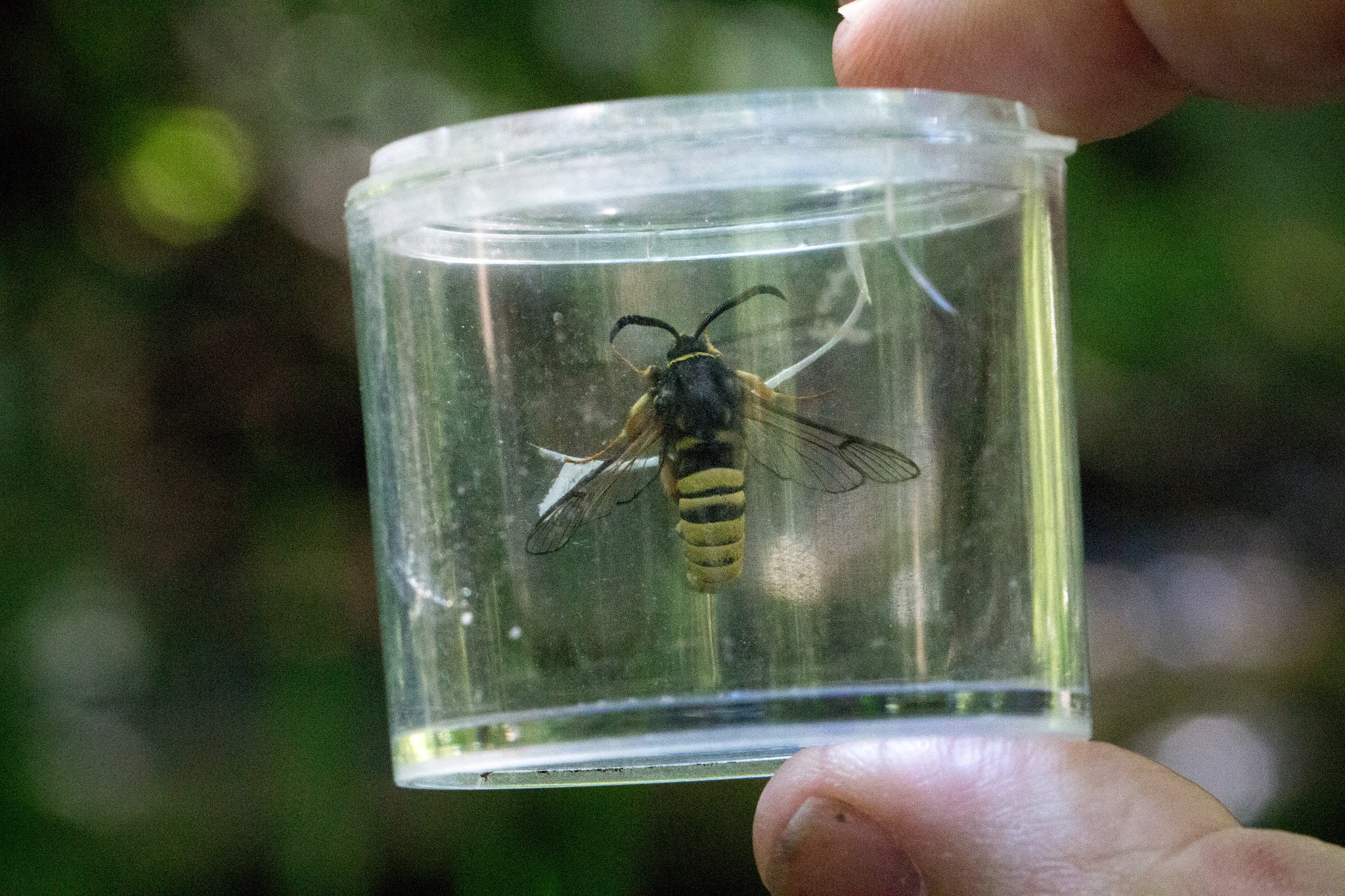
The Lunar Hornet Moth looks, sounds and flies like a hornet or giant wasp.  It is one of a group of clearwing moths that use Batesian mimicry to deter predators, that is they disguise themselves as something more dangerous and unpalatable to a potential predator.

Since 2020 a synthetic pheromone has been commercially available and reports of adult moths have increased dramatically.  This is the third year in a row I have had a go with a lure and all these photos are of males attracted to a pheromone lure in the past week.  (The female moth looks very similar but is larger.)  Once the moths have been in the trap for a few minutes they calm down and are happy to sit on a willow trunk for a few minutes while they gather their thoughts before flying off.


The photos on or in the trap aren't much good so I had a go at flight shots which are tricky but a few came out OK.  This one was taken in natural light and the shutter speed wasn't fast enough to freeze the wing movement.  

These were taken with flash.


For comparison here are a couple of European Hornets (Vespa crabro), also from Gosforth Nature Reserve but a few years ago.  They are brown rather than black but otherwise the moth's mimicry is pretty impressive.

Thursday, 14 July 2022

A sheep in wolf's clothing


This is the most impressive example of Batesian mimicry I have seen (= being disguised as something dangerous when you aren't).  Although it is called the Lunar Hornet Moth (Sesia bembeciformis), this looks much more like a giant wasp - hornets are mostly yellow and brown. Indeed, when you see several flying around your head it is difficult not to flinch at first.

Lunar hornet moths are fairly widespread but seldom seen.  Males can, however, be tempted into view with a pheromone lure which mimics the scent of a female moth.  The larvae live in willows and chew their way through the wood for two years before emerging for a brief life as a moth so willows are obviously the best place to find them.

Last weekend I joined Andy Atkinson and the NHSN moth group to look for these moths in Gosforth Nature Reserve.  Andy deployed the pheromone lure and two moths turned up within a few minutes.  As is usually the deal they had to pose for photos before being released.


I already had a lure and trap of my own so the next day I headed for another nearby nature reserve and deployed the lure just upwind of a patch of willows.  Within less than five minutes five or six moths appeared.  Lunar hornet moths are part of a group of clearwing moths and they even fly like wasps so the deception is nearly perfect.  A moth like this would make a tasty snack for a bird but no self-respecting bird would take the risk.  The moths also make a wonderful, very low-pitched thrum as they fly.

The pheromone is in a small vial which sits in a cage under the green lid of the trap. Moths fly under the lid and fall though a yellow funnel into the chamber below, or that's the plan.

Only two moths entered my trap while the others flew around or landed on the roof.

This one is in the lower part of the trap.

I was more interested in just watching them than catching them and belatedly had a go at a few flight shots.  Not easy.


As before, the two in the trap agreed to pose for photos before being released.


It is amazing to be able to summon these moths seemingly out of nowhere.  I think next time I try, probably next year, I'll concentrate on trying to get better photos of them in flight.

Monday, 19 July 2021

The lunar hornet moth


This is another wonderful day-flying moth that can be attracted to a pheromone lure - the lunar hornet moth (Sesia bembeciformis).  I was privileged to join Andy Atkinson, our local moth expert, to look for this moth in Gosforth Nature Reserve.  It lives in damp areas of willow and sallow so Andy headed for an area of coppiced willow at the edge of the wetland.  The lure comes in a small capsule which is inserted into the top of the trap which is then hung on a branch. Male moths are attracted by the scent and may enter the trap or be netted as they fly around it.

In the second spot Andy tried a moth appeared after a few minutes and was expertly netted.

After release it posed for a photo before flying off.

Moments later there was a second moth, slightly smaller than the first.

It also allowed me a photo after release.

The female moth lays her eggs on the willow bark and the larvae burrow into the wood.  They spend two years eating willow wood before emerging as adults.  Paul Drummond, the reserve warden, showed us a section of coppiced willow containing a lunar hornet tunnel.

This particular larva had not made it to adulthood as it had been predated by a woodpecker.

The lunar hornet moth is one of several similar moths known as "clearwings" that mimic other insects.  It looks more like a queen wasp than a hornet and even flies like a wasp, a very convincing example of Batesian mimicry.  The adult moth may trick the birds into avoiding it but that obviously doesn't always work for the larvae.