My Blog List

Showing posts with label Emperor moth. Show all posts

Thursday, 1 June 2023

Emperor moths

The Emperor Moth pheromone lure is amazingly potent.  I have tried it out twice this year and each time it produced six male moths within a few minutes.  The first time was at Hepple, west of Rothbury in Northumberland, on the heather moorland near the border with Harwood Forest. The lure is hidden under the bark of a bit of dead wood.  To start with the moths were flapping around like crazy, making it almost impossible to get a photo.  Then one settled on the wood very briefly,

and another landed in the heather nearby and stayed still for several minutes.

A few days later I took the lure to Edmonbyers Common in County Durham.  This was old scruffy heather but the moths arrived within a couple of minutes.  Here you can see three with the pheromone-impregnated lure tucked under the bark.

Here are two fighting to get to the imaginary female.

They are very excited when they arrive but sometimes seem to get tired and just stop for a rest, which makes the photography much easier.  This one stopped on the wood for several minutes, probably exhausted.

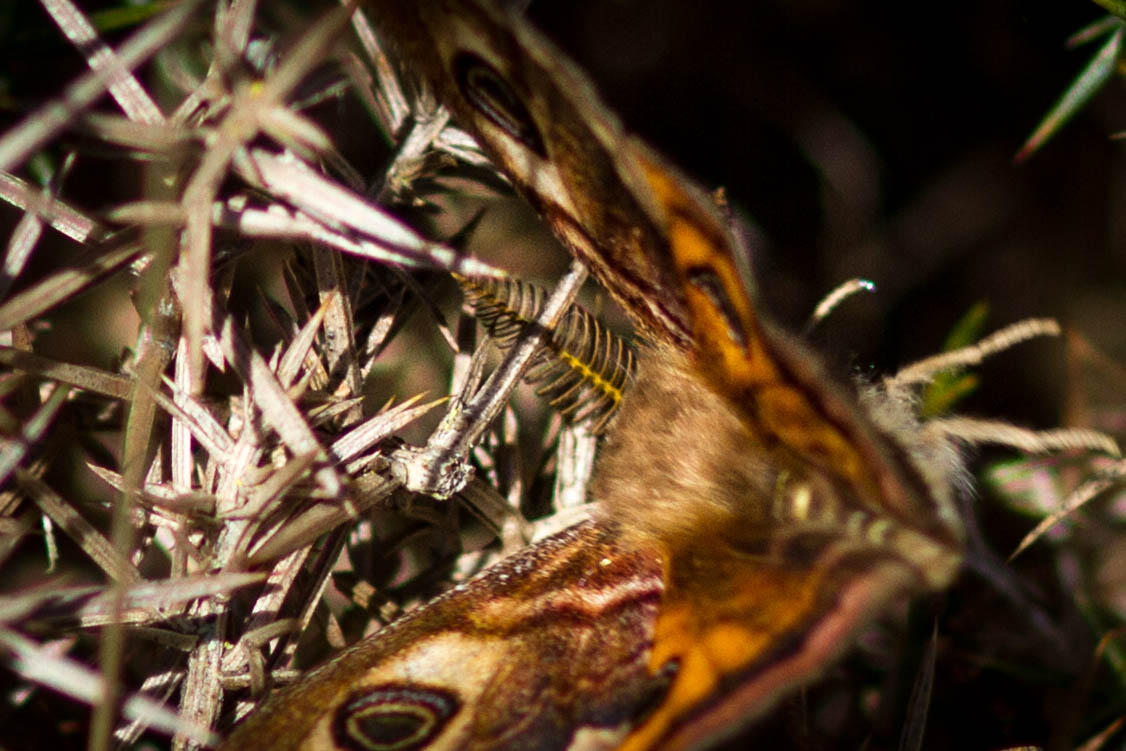
It has amazing feathery antennae to pick up the faintest scent of a female.

Eventually I picked it up to be out of the way of the others.  I had taken great care not to get any pheromone on my hands but it was a cold day and the moth seemed happy to be on my warm hand.


I found another rather faded and tattered moth in the grass a metre or so away.

And another worn and tatty individual.

I have yet to see a female Emperor Moth.  She is larger and has the same markings but the background is pale blue-grey, even more beautiful than the pink-brown of the male.

Friday, 6 May 2022

The emperor moth


I think this is quite the most beautiful British moth.  This is a male emperor moth, Saturnia pavonia.  It flies in late spring and lives in upland areas.  Males can be enticed into view using a pheromone which mimics the scent of a female.  The males fly in the daytime but the females are said to fly only at night.  I wonder if the females attract males for mating by day but then feed and lay eggs at night.

Just over a week ago I took the pheromone lure, hidden behind the bark of a small log, to Simonside near Rothbury, where I had first seen an emperor last year but this time there was no response.  I moved round to Harwood Forest and within a few minutes a moth appeared.  It flew around incessantly, only pausing for a fraction of a second, so this photo was the best I could do.

On Sunday I went back to Muggleswick in County Durham, which yielded the best photos last year but again drew a blank.  A few miles further south I tried again on the Waskerley Way and a moth arrived within ten minutes.  A few minutes later there were six, all zooming round looking for the non-existent female.  They fly manically so the photography is challenging.  Nearly all the photos are out of focus, or motion-blurred, or miss half the moth, or don't include a moth at all.  Here are a few that turned out OK.


This was the only time I had two in the frame together.

This male discovered the lure and realised it was a con.

The others also disappeared after a few minutes so I moved a few miles west to Horseshoe Hill.  There another four moths arrived to investigate so this seems to be a pretty good area for them.


One of these moths was a bit tatty and looked rather tired with all its exertions and it flopped down onto the grass for a rest so I could even get a photo with the phone.

I had taken great care not to get any trace of pheromone on me or my hands but it did accept the offer of a lift onto my hand for a photo.

My next challenge will be to find and photograph a female emperor but that won't be so easy.

Monday, 7 June 2021

Summoning the emperor


The emperor moth (Saturnia pavonia) is one of our most spectacular day-flying moths but although it is fairly widespread it is not often seen.  There have been only four records in the vice county of South Northumberland (VC67) on iRecord in the last five years and three of those were caterpillars.  Male emperor moths can be attracted to a pheromone lure impregnated into a small rubber bung.  It must not be handled or touched on any vegetation so as not to leave a trace which might distract male moths.  It also shouldn't be used for more than 30 minutes and shouldn't be left unattended.  Having read all the instructions and having consulted the Northumberland Moths website to find the history of local records I decide to try when I went up to Simonside to look for bilberry bumblebees a few weeks ago.  I hung the lure on a willow branch using a surgical clip and was astonished to see a moth appear within four minutes.  It flew around madly within a radius of about 30m but I never got close to taking a photo.  After five minutes or so it realised the whole thing was a scam and flew away.  Ten minutes later it (or another one) returned and the whole episode was repeated.  Still no photo but it was promising start.

I have been wanting try in the south of the county but throughout most of May the weather was cold and wet.  Finally it improved last weekend so I went to Muggleswick with friends Denise & Phil to look for the moth, amongst other things. As we started looking for green hairstreak butterflies I hung out the lure.

This time it took only a couple of minutes before a moth appeared.  Again it was very active but I managed a few blurry pictures which at least confirm the ID.


Emperor moths fly in April and May so we were already right at the end of the flight period - although it may be delayed this year by the cold spring.  So two days later I decided to have one last attempt and returned to Muggleswick.  This time I set a stopwatch and it took 90s for the moth to appear from what looks a superficially unpromising habitat - just burnt heather and scrubby gorse.

This short video shows how the moth flies and illustrates the challenge for photography.

The moth stayed around for 10 minutes and occasionally paused for a fraction of a second, just long enough for a photo.  This one and the photo at the top of this post were the best of them.

A few of the other photos show the moth's extraordinary antennae with which it can detect the faintest whiff of pheromone.  The last two are very heavily cropped.


The female is larger than the male and flies at night so is much harder to see in the wild.  She has similar markings to the male but is grey/blue.  You can see beautiful photos of the female on the Butterfly Conservation website.  My pheromone lure is back in the freezer but I shall be trying it out at a few other locations next year.