My Blog List

Showing posts with label Caterpillar. Show all posts

Tuesday, 15 October 2024

A few creepy-crawlies

This blog has been overrun by weasels and shrews in recent weeks so invertebrates have barely had a look in.  OtterCam, WaterShrewCam and WeaselCam are quiet at the moment so I have a chance to post a few odds and ends I have come across recently, while looking for something else (usually dragonflies or ladybirds).

The first is a mite, Anystis baccarum, also known as the whirligig mite.  It is a predator of aphids and is available as a biological control for aphid infestations in apple orchards.  This one was munching on an aphid on a gravestone.  The mite is 1.5mm across.

Next a tiny beetle that should be in the list of things that are not ladybirds.  It is Sphaeroderma rubidum, a leaf beetle about 2.5mm long.  It feeds on the leaves of thistles and knapweed.  It overwinters as a larva so this adult won't survive for long.


Another beetle, a Rosemary Beetle, this one about 8mm long.  Although its scientific name is Chrysolina americana it comes for the Mediterranean.  It first arrived in the UK in 1994 and is now widespread.  The larvae feed on rosemary, lavender and thyme.

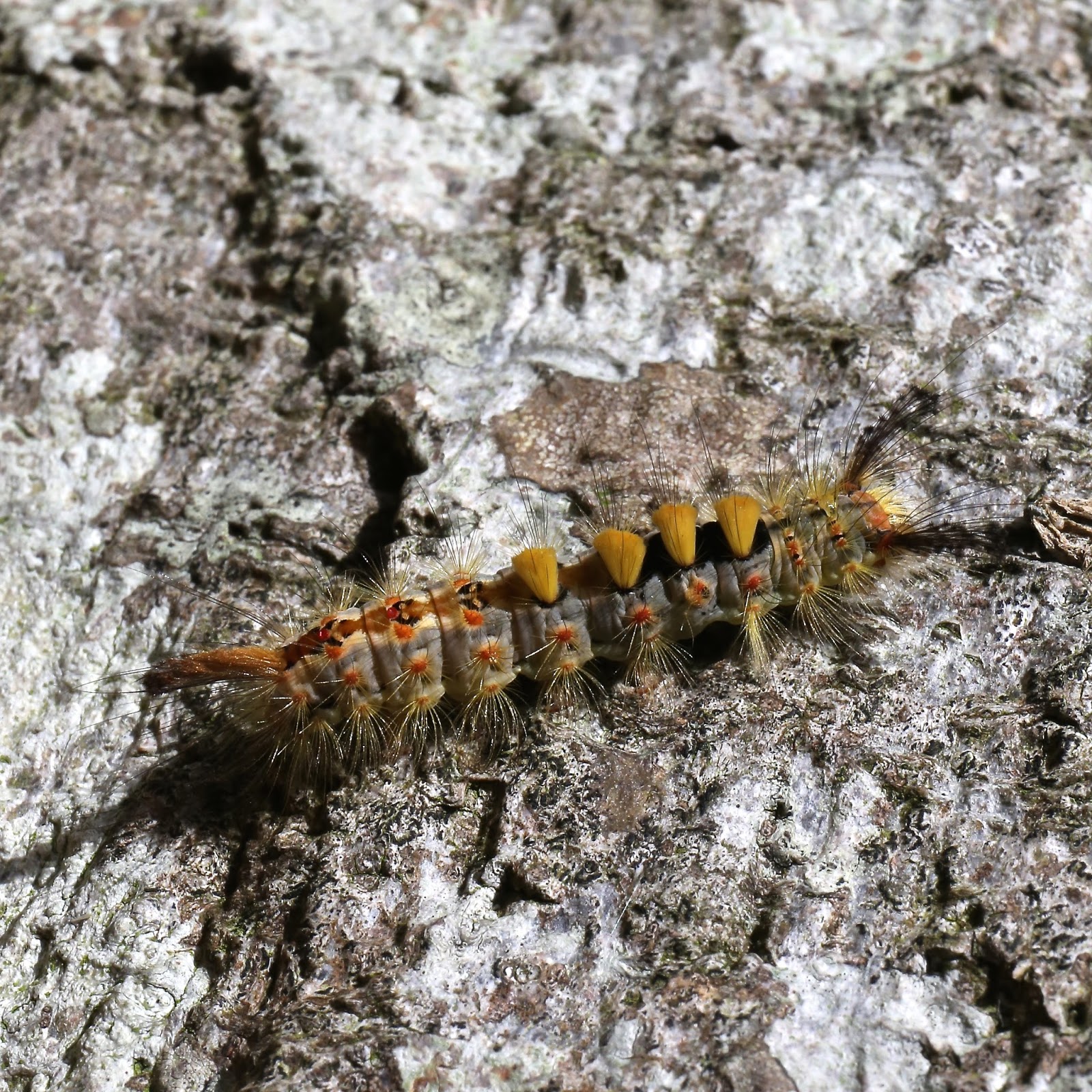
And a Grey Dagger Moth caterpillar (the head end is to the right).  It overwinters as a pupa so this one won't be a moth until next year.

I have seen a Grey Dagger in my trap before.  While the adult moth is indistinguishable from the Dark Dagger, the caterpillars are similar but not identical.

I expect we'll be back to trail cameras next time.

Wednesday, 2 September 2015

The Very Hungry Caterpillar

This beautifully camouflaged caterpillar is the larva of a poplar hawk-moth, seen at RSPB Saltholme.  It is head down and the horn is on its tail.  It holds on with four pairs of green prolegs.

The mouth is small and in front of six small red legs which help hold the food..

This one was eating willow leaves, presumably having finished all the poplar leaves!

Thursday, 27 August 2015

Rusty tussock moth caterpillar

I was on a landscape photography workshop in Dorset and was supposed to be making photographs of an avenue of beech trees when I was distracted by this caterpillar climbing up one of them.  It is the larva of a Rusty Tussock Moth, also known as the Vapourer, and has the strange scientific name of Orgyia antiqua.  The caterpillar has two black tufts of hair on its head, four bright yellow tufts along its back and an orange tuft at the rear.

The adults exhibit extraordinary sexual dimorphism, meaning that the two sexes look very different.  The male is a handsome orange-brown moth with a white comma-shaped mark on each wing.  The female looks like a furry woodlouse and is flightless.  For more details and pictures of the adult moths click here.


I never did get a good photo of the beech trees.