The long-tailed tit is a favourite amongst birdwatchers and photographers and must count as one of our cutest birds. At this time of year long-tailed tits are still in large groups (known as tribes) but they will soon break up into pairs for the nesting season. They come to the feeders more regularly at this time of year, probably because there is less natural food around for them. They prefer the suet feeder or peanuts and usually don't stay long.
The long-tailed tit is Aegithalus cordatus. These BTO Garden BirdWatch data suggest it is becoming more common as a garden visitor and show the peak in late winter.
The population has been increasing in recent years.
It is found throughout most of lowland England and Wales.
Thomas Bewick made this engraving for A History of British Birds (1797).
Archibald Thorburn painted long-tailed tits on several occasions.
You can read more about long-tailed tits here. And listen to the BBC Radio 4 Tweet of the Dayhere.
This clip was shot hand held through the back door window. A 60W wall light provides the only illumination. I used an external microphone, hoping to pick up the chewing sounds, but they were drowned out by the stormy weather.
Up to five foxes come for food every night but the hierarchy seems well sorted now and I now usually see only one at a time, although sometimes a pair. I am beginning to recognise individuals.
Wow. Another first for the garden. I posted recently some photos of the deer eating the ivy on the fence outside the gate but after that they didn't return until a few nights ago. I saw that the ivy was stripped bare up to browsing height so I knew they had been back. The perimeter of the garden is (more or less) rabbit proof so I always keep the gate shut at night to stop any rabbits getting in. As there have been hardly any rabbits around for ages I decided to leave the gate open three nights ago to see what happened. I set up the trusty old Wingscapes camera near the gate and I was also trying out a new Browning trail camera (more on that another time) on the foxes by the back door. The Browning probably wasn't set up properly as it took over 6000 photos of foxes chewing peanuts (more on that another time as well!). However, there were also these photos.
This is the first time a roe deer has been in the garden. I checked the old Wingscapes but this was all it had managed. I think its reactions are about as slow as mine.
Two nights ago I was better prepared. I set the Browning by the gate to record video but I can also extract still frames from the video. Roe deer are small. To give you some idea the top of the gatepost is 1.27m (50 inches) high, so to the tops of his antlers he is only about 1m tall.
Looking through the recordings I can see that the buck stayed in the garden eating the ivy for quite a while. He arrived at 0150, left at 0230, came back again at 0437 and left again at 0503. Much of the time he was out of sight of this camera and I had forgotten to put a card in the other one! However, here are three videos from the Browning.
Last night wasn't so good. When I got home just before ten the buck was already outside the (closed) gate and ran off. I left the gate open again and he returned during the night. The video camera was in similar position to the previous night but it only took two useful shots as he walked in and later walked out.
And the Wingscapes wasn't much better than the night before!
I'll keep trying to get some colour stills and I plan to use two different camera positions tonight.
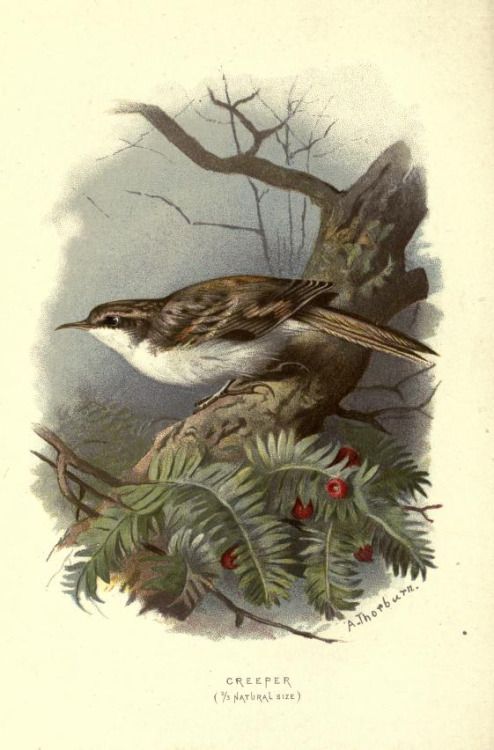
A pair of treecreepers (Certhia familiaris) have been daily visitors to my woodpecker feeder this week.
I read that females forage on the upper half of tree trunks while the males take the lower halves. I am not sure how that was worked out because the sexes look alike. If true, it is an interesting division of labour.
At one stage while I was watching the sparrowhawk alarm went up. All the other birds fled but the treecreepers froze, relying on their camouflage for protection (interestingly great spotted woodpeckers do the same thing despite their colouring). In the end it was a false alarm, as most of them are.
BTO data show that the UK population is fairly stable, although these are small secretive camouflaged birds so they can't be easy to survey.
Treecreepers are woodland birds and are infrequently recorded in the BTO Garden BirdWatch data but numbers peak at this time of year.
Thomas Bewick made this woodcut for A History British Birds (1797).
Archibald Thorburn painted treecreepers several times.
You can listen to Bill Oddie's BBC Radio 4 Tweet of the Dayhere.
Being an ambush hunter involves a lot of sitting around waiting for something to happen. I have seen him do this a couple of times. I know sparrowhawks cough up pellets (like owls and kingfishers do) but nothing appeared and I haven't found any pellets below his perch. This happened during his stretching and preening routine so I think he was just yawning. In the second photo his third eyelid is covering his eye as a reflex response.